
Nkechi Ebubedike, See-Saw (detail), featured in AGNI 104
Skin without Flesh
Stone, in labor, becomes fluid. Fluid, in time, becomes stone again. Limestone, heated to around 800°C, becomes quicklime; mixed with water, it becomes a soft, binding putty. Exposed to air, it slowly hardens again, absorbing carbon dioxide and returning to limestone. In this cycle, stone becomes temporarily malleable, a substance that can be spread across a wall, pressed into a floor, or shaped around a bone. As it hardens, it remains permeable, allowing moisture and air to pass through.
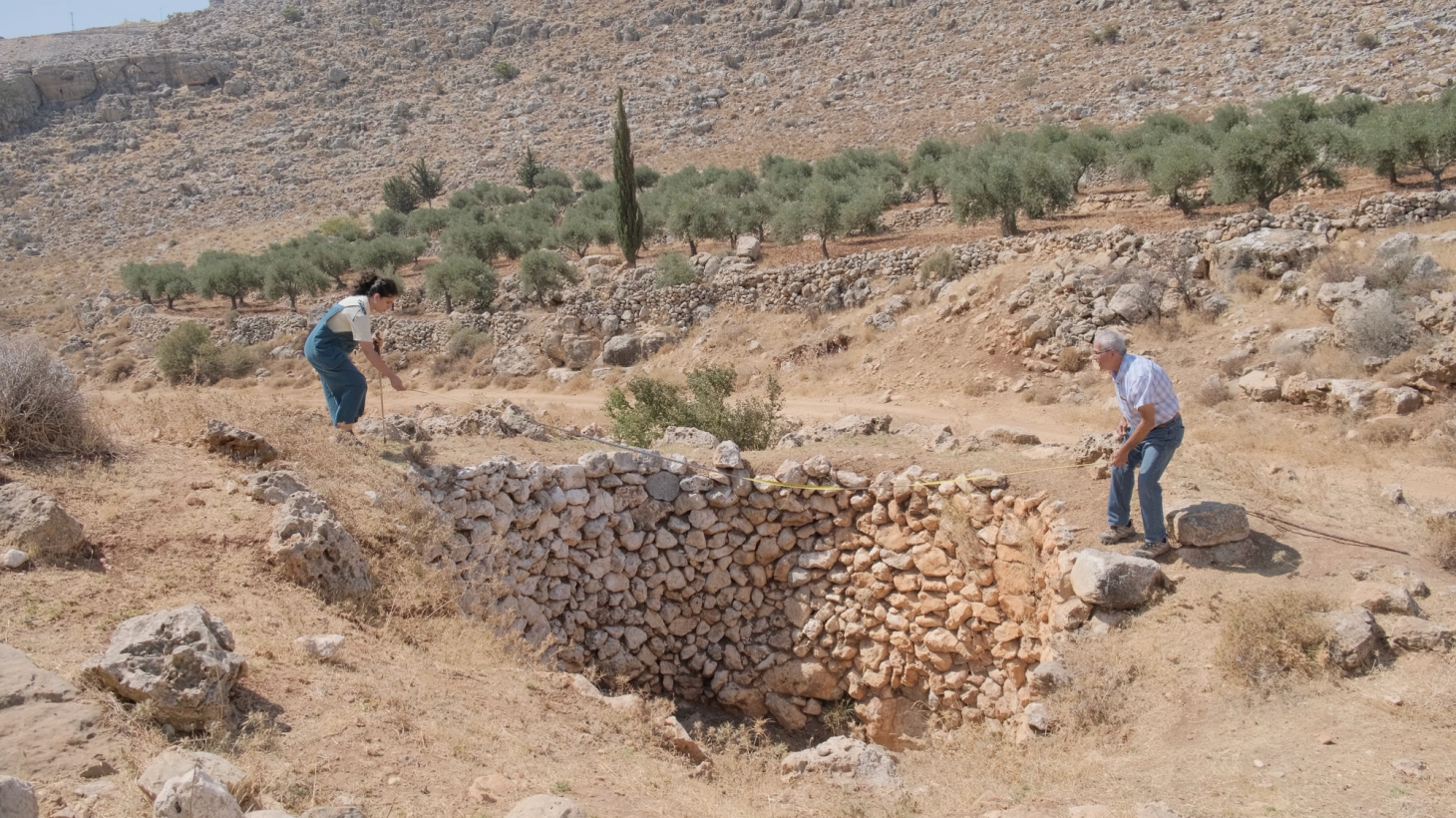
I began to understand this cycle through a failed attempt to make lime. In 2024, I built a prototype lime kiln at the Wonder Cabinet in Bethlehem, modelled on inactive lime pits I encountered across Palestine’s highlands. Rural lime burning has declined in Palestine since the 1970s with the widespread adoption of Portland cement. Its decline coincided with the erosion of several forms of knowledge that can only be sustained through a close relationship with the land—a relationship increasingly severed by ongoing settler-colonial practices of enclosure and dispossession. Historically, lime burning was more than firing stone: it required knowledge of the geological formations from which the stone was gathered, collecting and compressing thistles for fuel, reading the wind’s corridors and seasonal rhythms, and keeping a fire alive for up to a week. Reconstructing these processes in the present made the ruptures visible in ways that an inactive pit, as a stagnant structure, could not.
To recreate this process, I had to work with various experts: Riyadh Salah contributed his experience in stone masonry and terrace building; Dr. Hamdallah Bearat brought a knowledge of kiln kinetics and lime chemistry; and musicians Mohammad and Ibrahim Abu Laban and I reinterpreted melodies from the chants that once accompanied lime burning. Even with help, we could not source enough fuel to reproduce the conditions of the historical kilns, and the fire could not be sustained for more than two nights.
Historically, lime’s production and use were tied to the ongoing care for a house. Lime was widely used for plastering walls, roofs, floors, and wells. A plastered house, writes historian Tawfiq Canaan, is locally described as “dār shamsiyyeh qamariyyeh”—a sunny and moony house—one built to receive both sunlight and moonlight. Plaster was not merely a protective finish but what turns a shelter into a home through patience and time. Roofs were annually replastered. The plaster used for wells often incorporated crushed pottery, whose silica particles made the mortar hydraulic and therefore more resistant to water. The plaster of floors was pressed and polished with the smooth surface of a piece of marble, using oil and soap as a lubricant. Wall plasters varied between coats. Coarser mixes formed the structural layers, while finer, more lime-rich blends were used for finish.
Palestinian homes are still continually repaired and renewed, though their surfaces are now made from concrete, gypsum, and synthetic paints. Lime offers a different kind of intimacy, making tangible the distances between community and land, water and earth, atmosphere and dwelling, without collapsing them into one another.
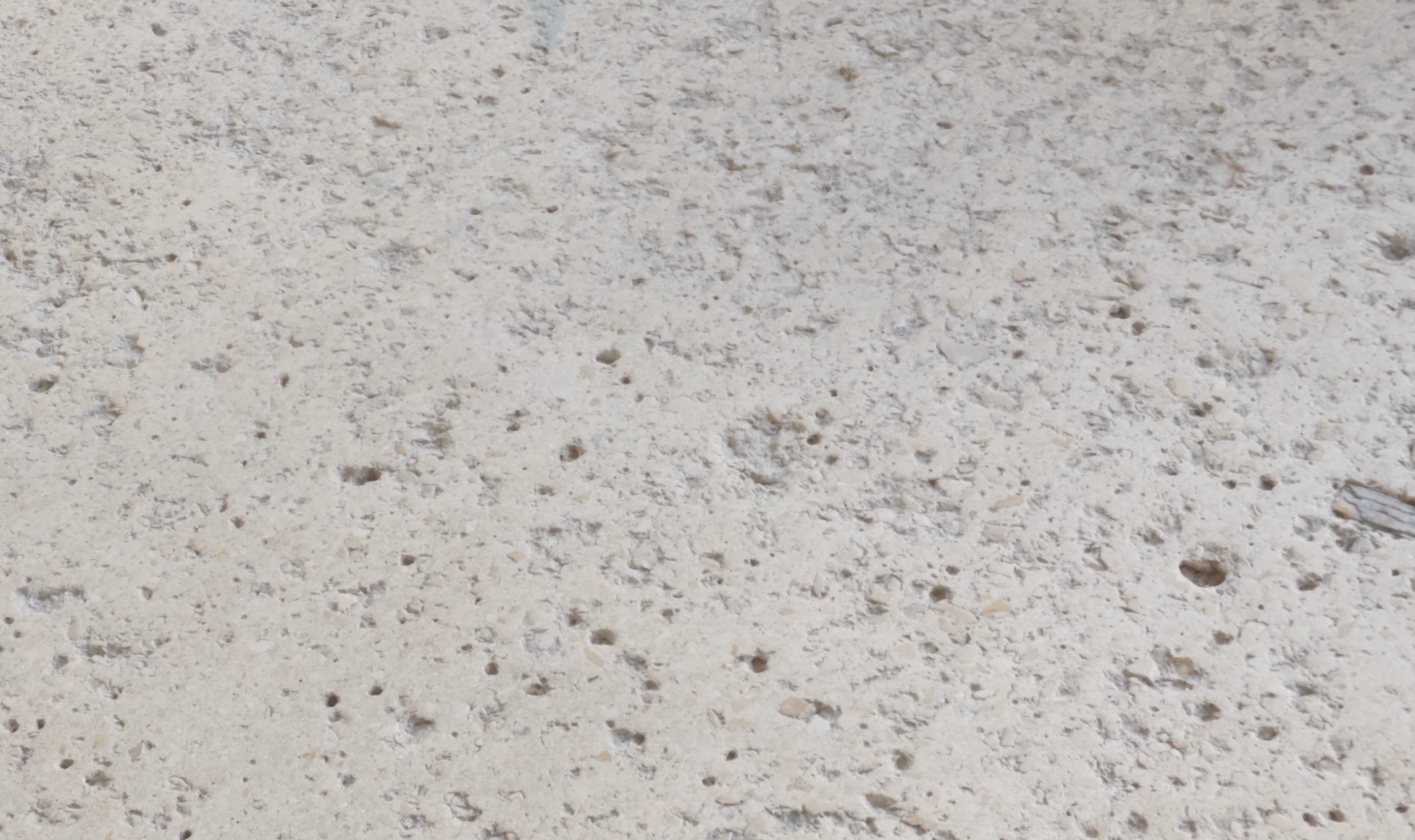
In prehistoric lime-plaster floors found across the region, another distance becomes perceptible: that between the living and the dead. In Neolithic dwellings, the dead were sometimes buried beneath floors where people lived. There’s even evidence that sometimes skulls were removed after burial and remodelled with lime plaster. Were they turned into masks? Ritual artifacts? Or was this a funerary practice? No one knows if these plastered skulls were passed between generations or reburied soon after their making. What is known is that the same material that surfaced a house was used to mimic the skin of those lost—and that the living were invested in their relationship with the dead.
When I first learned about these plastered skulls I couldn’t help but think of the present, and all the remains of Palestinian bodies that have been recovered over the past three years. The dead remain part of a community through the labor of the living. The living wash and prepare their bodies, gather around them, return to their graves, and carry their presence through repeated acts of remembrance. In Gaza, where tens of thousands of Palestinians have been killed in the ongoing genocide, many bodies remain unidentified, fragmented, buried in mass graves, and separated from their families and communities.
What happens to a community when the rituals through which the living remain connected to the dead become impossible to carry out?
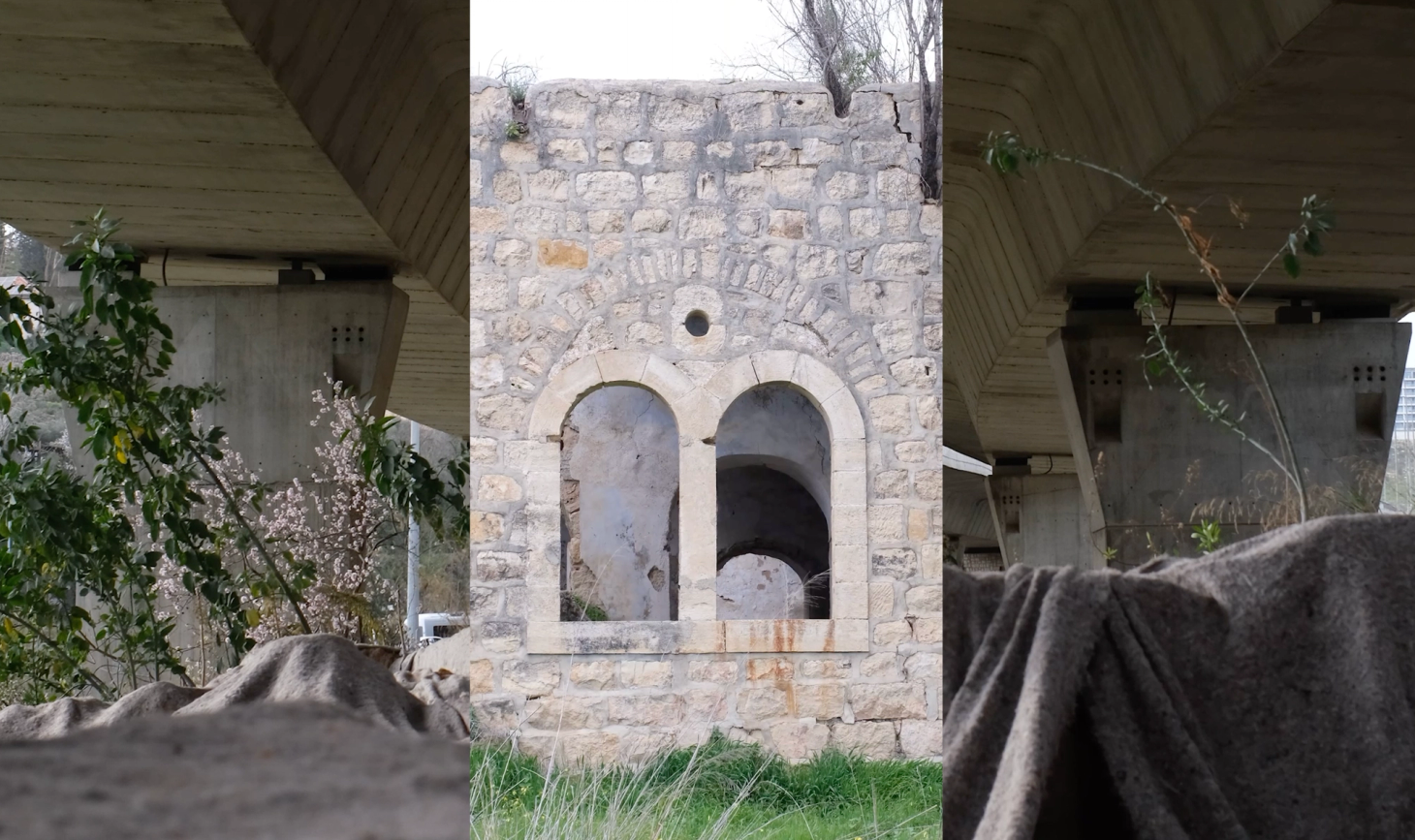
I first encountered these Neolithic burial practices near Qaloniya, a Palestinian village ethnically cleansed in the 1948 Nakba and subsequently destroyed. In early 2026, I visited the site with an archaeologist who had taken part in the Israeli-led salvage excavation that uncovered these burials.
As we stood beneath the Israeli overpass that shelters the site and had prompted its excavation, he described the remains of Qaloniya. Inhabited only seven decades earlier, traces of the village’s marah—where the livestock was kept—and the nuqbeh—a shaft dug to reach underground water—were already out of sight: studied archaeologically and then destroyed or reburied. The nearby Neolithic settlement had likewise been excavated and then destroyed to make way for development. What remained intact was an Iron Age temple, still under study for its potential Biblical significance.
Bassem Khandakji’s novel, A Mask, the Color of the Sky, written in prison, explores how access to the ground—and its multiple histories—is restricted under settler colonialism. In the novel, a Palestinian protagonist uses a found Israeli ID card to gain entry to an excavation site otherwise closed to him. At Qaloniya, I encountered a ground whose material traces had already been altered. The excavated Neolithic floor was accessible to me only through a digital photogrammetric scan, another form of mediated entry. Passed from ground, to excavated surface, to archaeological record, it offered a visual trace of what had been destroyed—a skin without flesh.
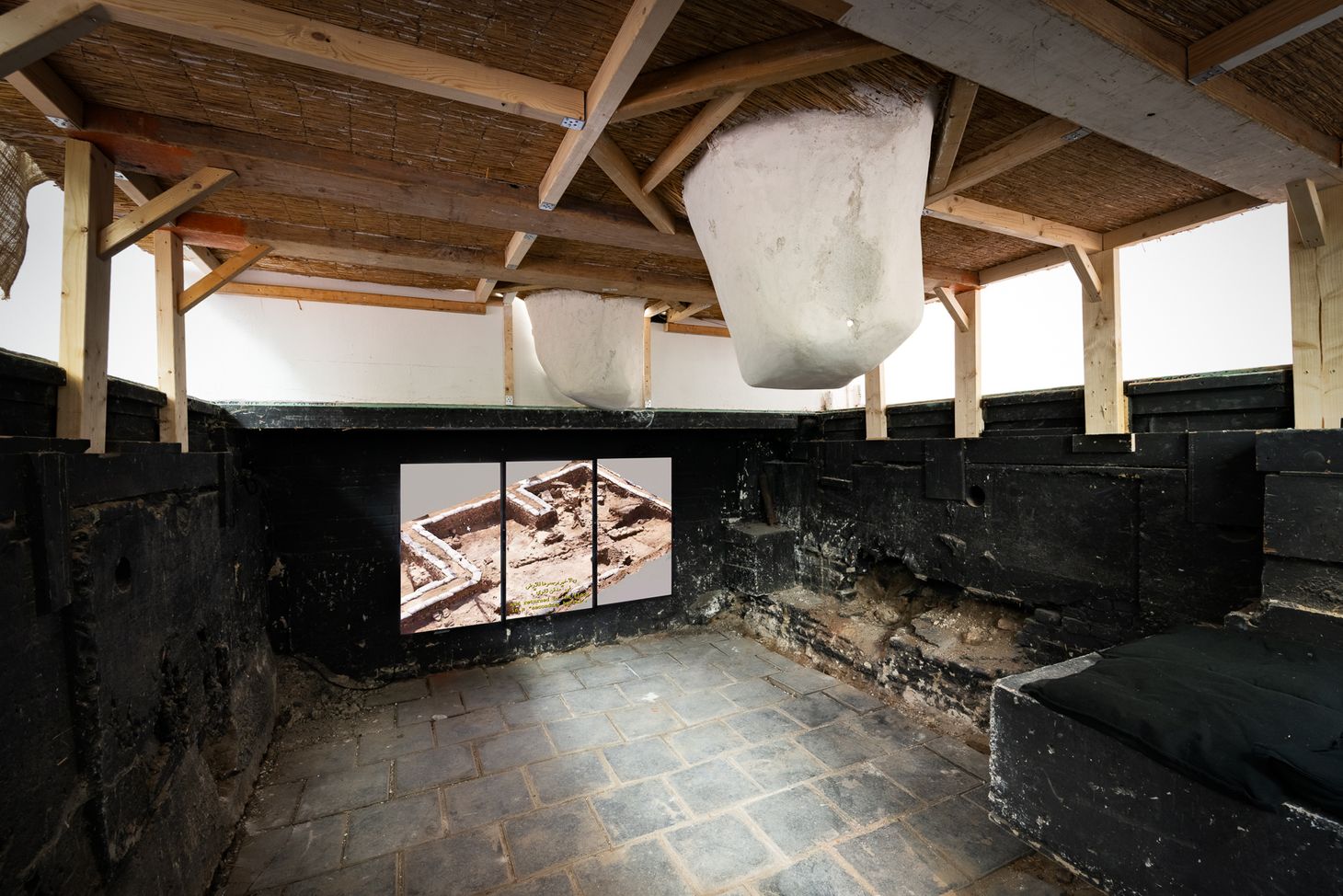
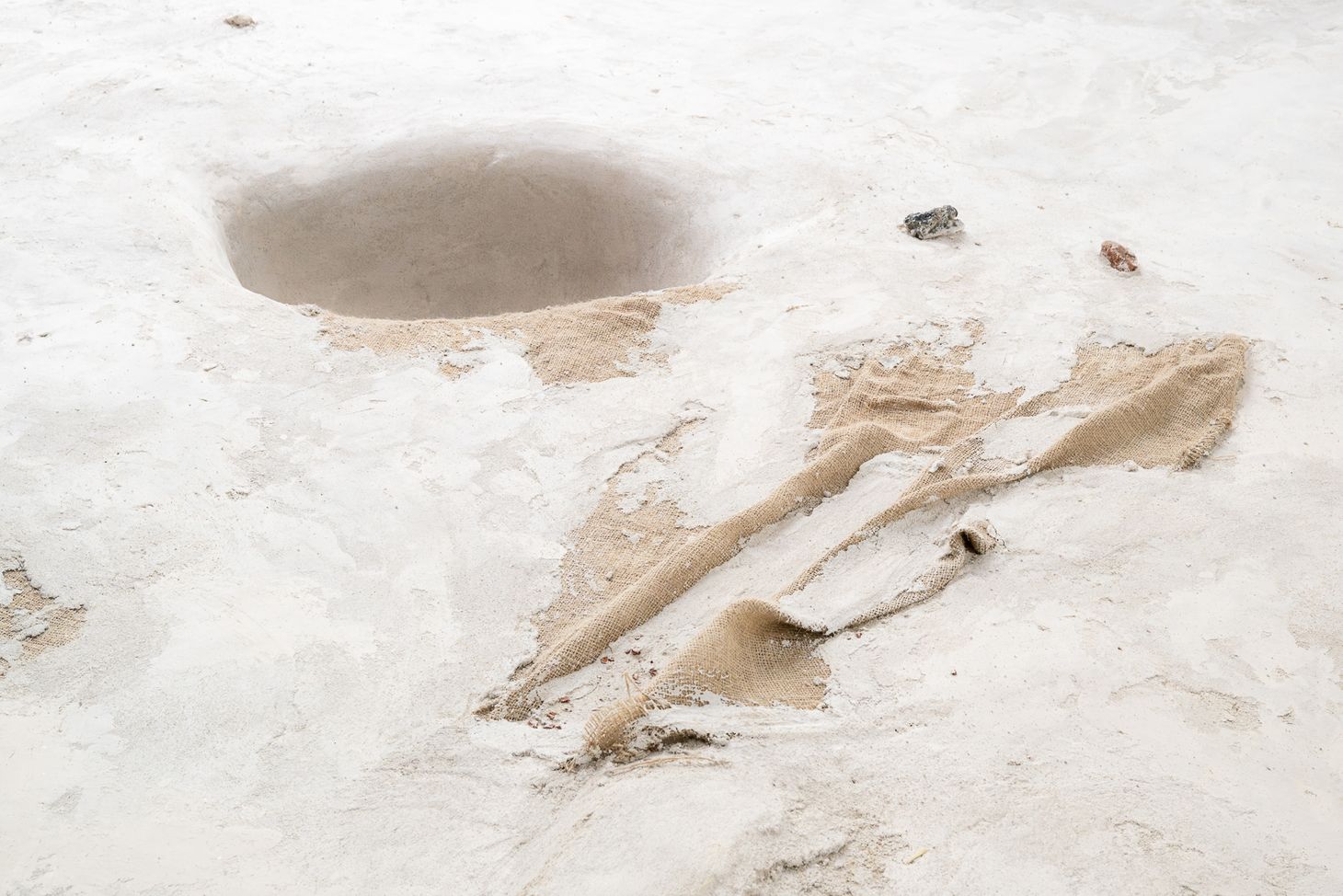
I began The Ground Keeps What It Holds, an installation commissioned by W139 in Amsterdam, with that digital trace. The work developed through an invitation from artist Maria Khatchadourian to join her and others in thinking about the ground as a field of entanglement—a convergence of soil, labor, and memory—culminating in the exhibition flour, water, soil. For my installation, I designed the skeleton of a floor from what I could glean from the photogrammetric scan, constructing it as a suspended structure; visitors could pass beneath, but above, it was too fragile to walk across. Two years after building and firing a lime kiln in Palestine, I was working with lime for the first time as a plastering material, to recreate the surface of a prehistoric floor. Following the same material process that has been used to make dwelling floors across millennia, I attempted to bring into contact layers that settler-colonial archaeology had dislocated. The surface, punctuated by three pits half a meter deep, equally suggests Neolithic burial pits, Iron Age grain-storage containers, or the mouth of a nuqbeh.
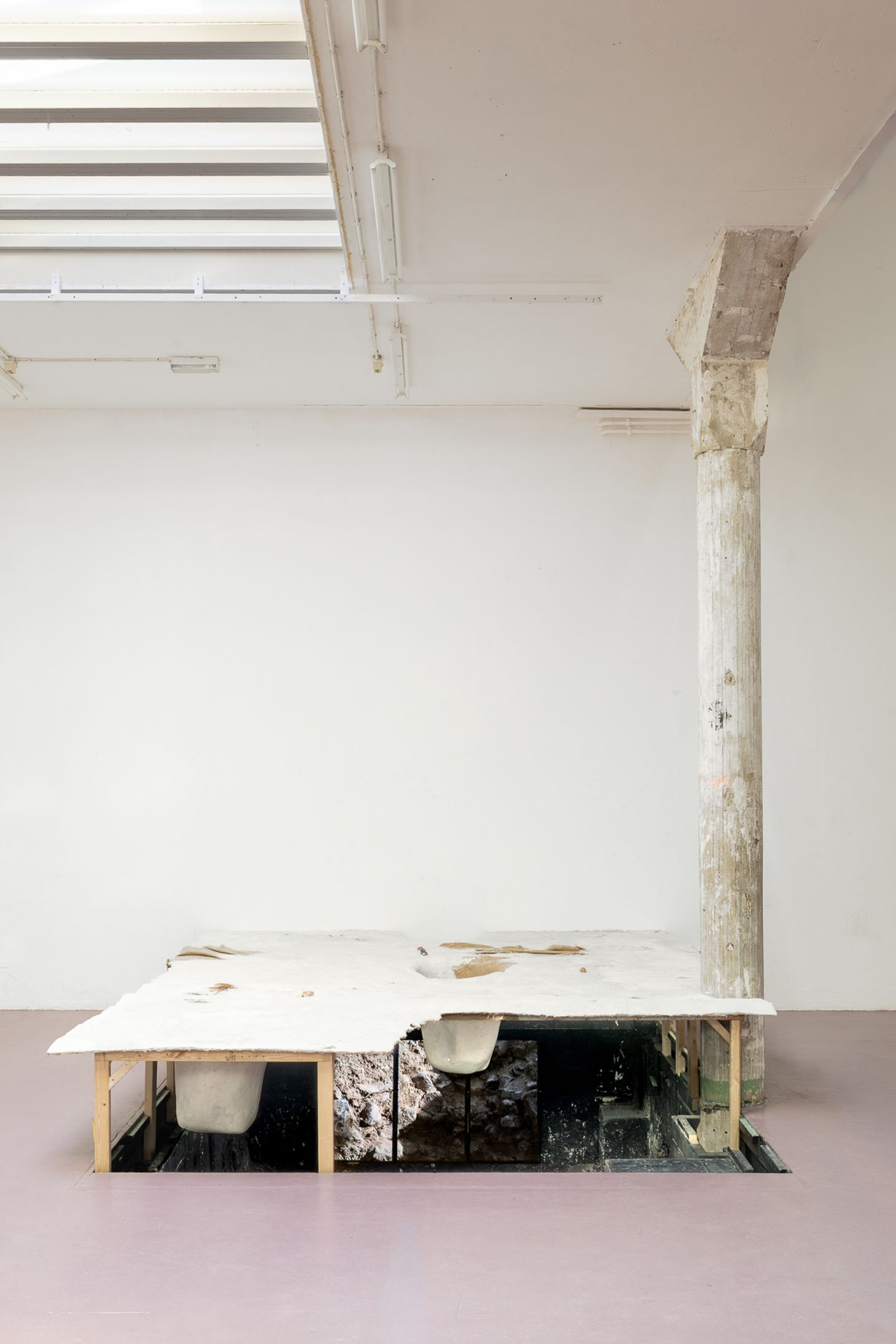
To make the lime plaster, I collaborated with plasterer Raquel Rodríguez Puebla from Architectural Skin, who had to remind me that “lime is the boss.” We had to wait and see how it interacted with the elements before adding additional layers. Raquel also had to repeatedly remind me to slow down and attend to this process. Eventually, I decided to cancel my other commitments and remain physically close to the lime. She calculated that it would carbonate at a rate of one millimeter a day, meaning we had to wait a full week for our seven-millimeter coat to set before adding the next one. Much of our negotiation with the material concerned how to prevent it from cracking over time as it clung to a thin, suspended base. The lime seemed to breathe and hold its shape as it carbonated, changing color and texture from one day to another.
Descending beneath the plastered structure, visitors encountered a three-channel video filmed at the excavation site near Qaloniya. A song recurs throughout. Researcher Omar Hamdan documented Palestinian lime burners’ work chants in interviews conducted in the late twentieth century. With Ibrahim and Mohammad Abu Laban, I reworked one of these chants into a song, “Yobi,” following a reimagined melody. At the finissage, sound artist Aimée Theriot wove the song together with recordings she made underground in the caves of Yucatán, Mexico. Across distant times and places, the voices meet in the ground’s echoes, in what it holds and what it keeps through the labor of the living.
The song, the floor, and the kiln are reconstructions—not recoveries—of forms of knowledge around lime that have been displaced or enclosed; they offer moments of being in contact with them, of keeping the distance through which proximity remains possible.
Areej Ashhab
Areej Ashhab is an artist, researcher, and architect based in both Jerusalem and Amsterdam. Working across installation, moving image, writing, and performance, her practice attends to land, material knowledge, and collective forms of learning in contexts shaped by structural enclosure and dispossession. Her work often develops through long-term collaborations, including with Al-Wah’at collective, Al-Block initiative in Jerusalem, and artist Raghad Saqfalhait. Within these collaborations, she develops experimental field methods that combine counter-mapping and hands-on material experimentation through workshops, walks, and shared meals. Areej is the coauthor of the artist book The Fast-Growing Stinking Escaped Waste-Loving Wall-Breaching Self-Cloning Other-Than-Natural No-Man’s Tree (Sharjah Art Foundation, 2024), and her writing has been featured in e-flux Architecture, The Funambulist Magazine, and The Avery Review. (updated 10/2026)