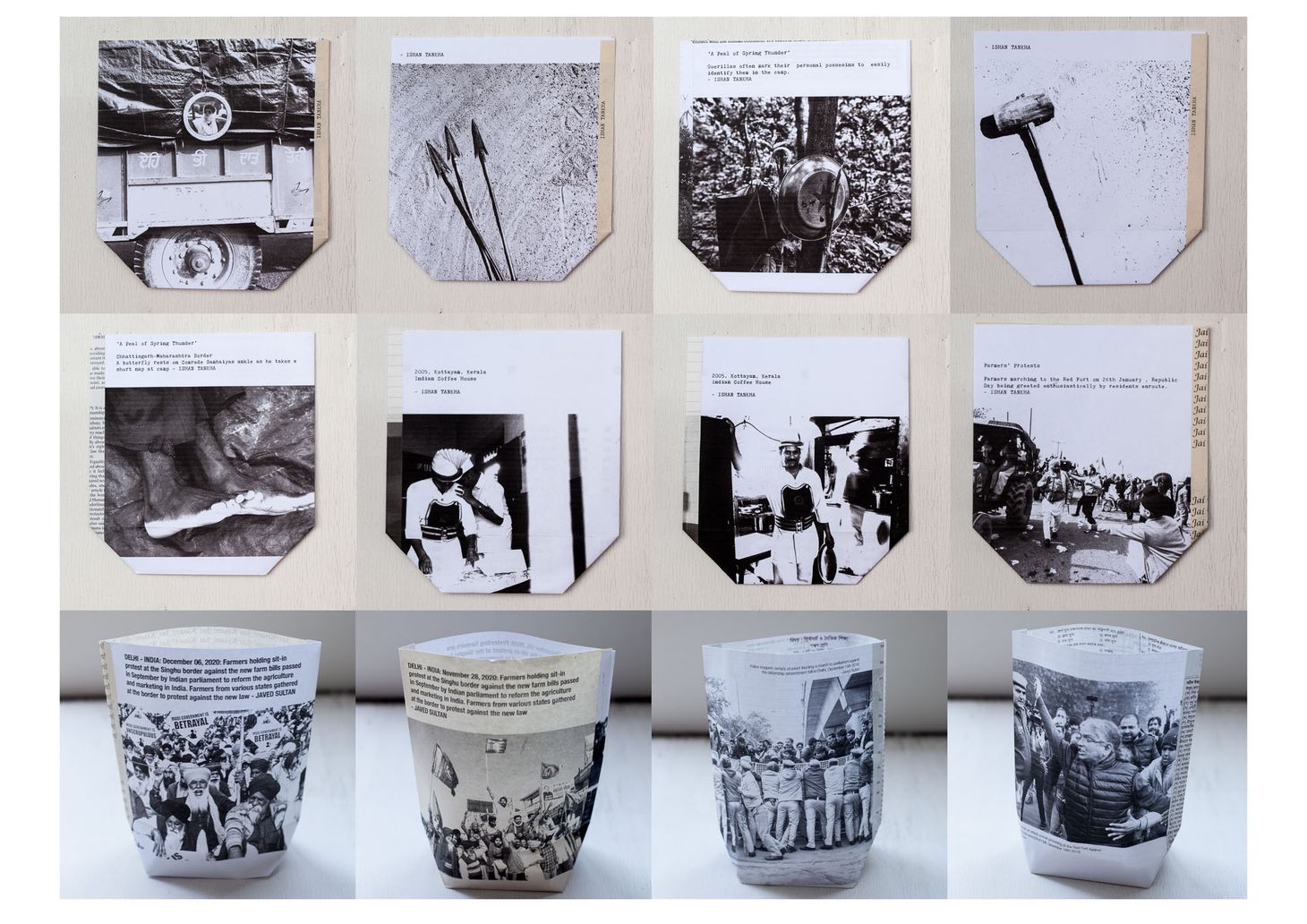
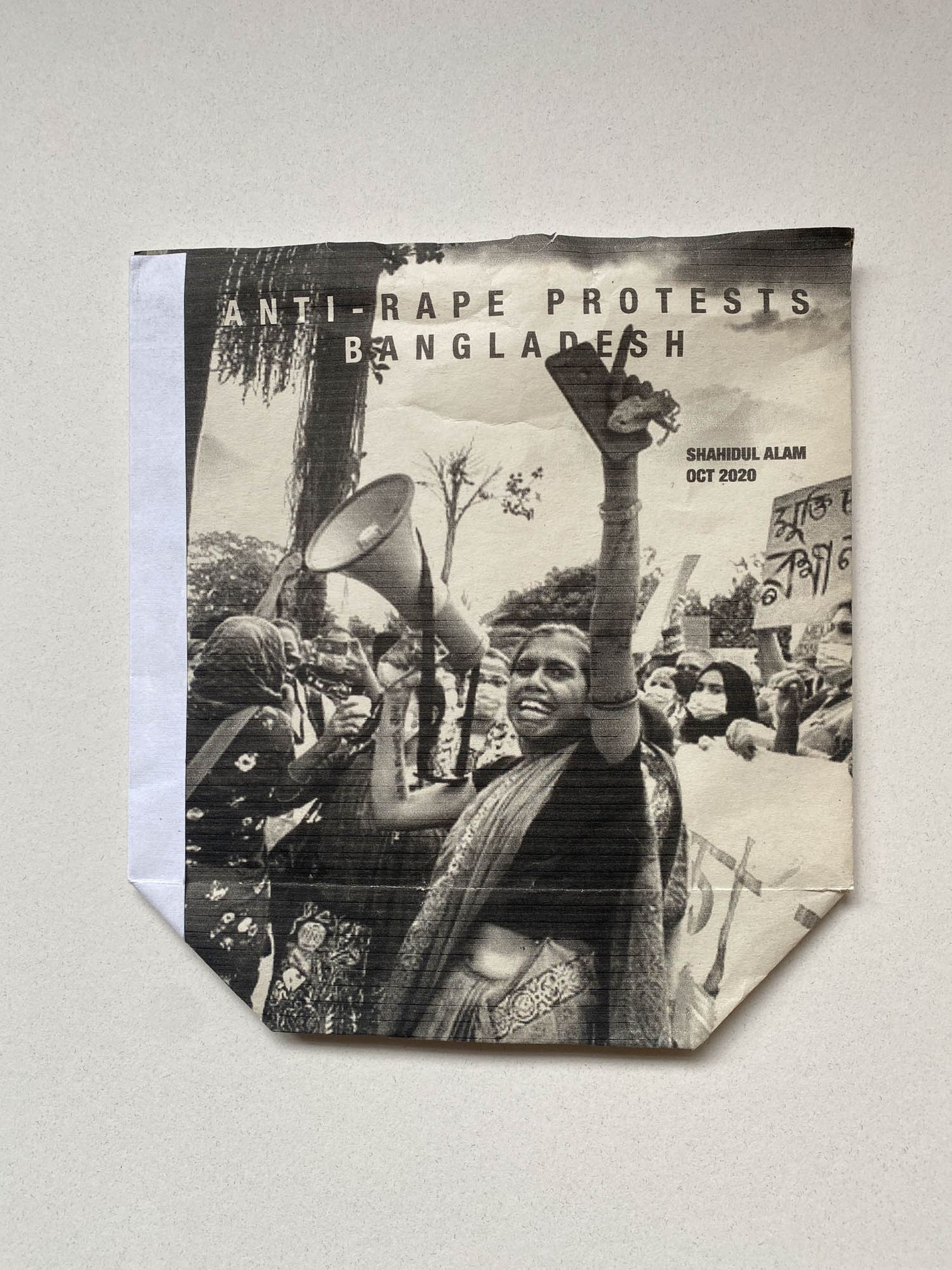
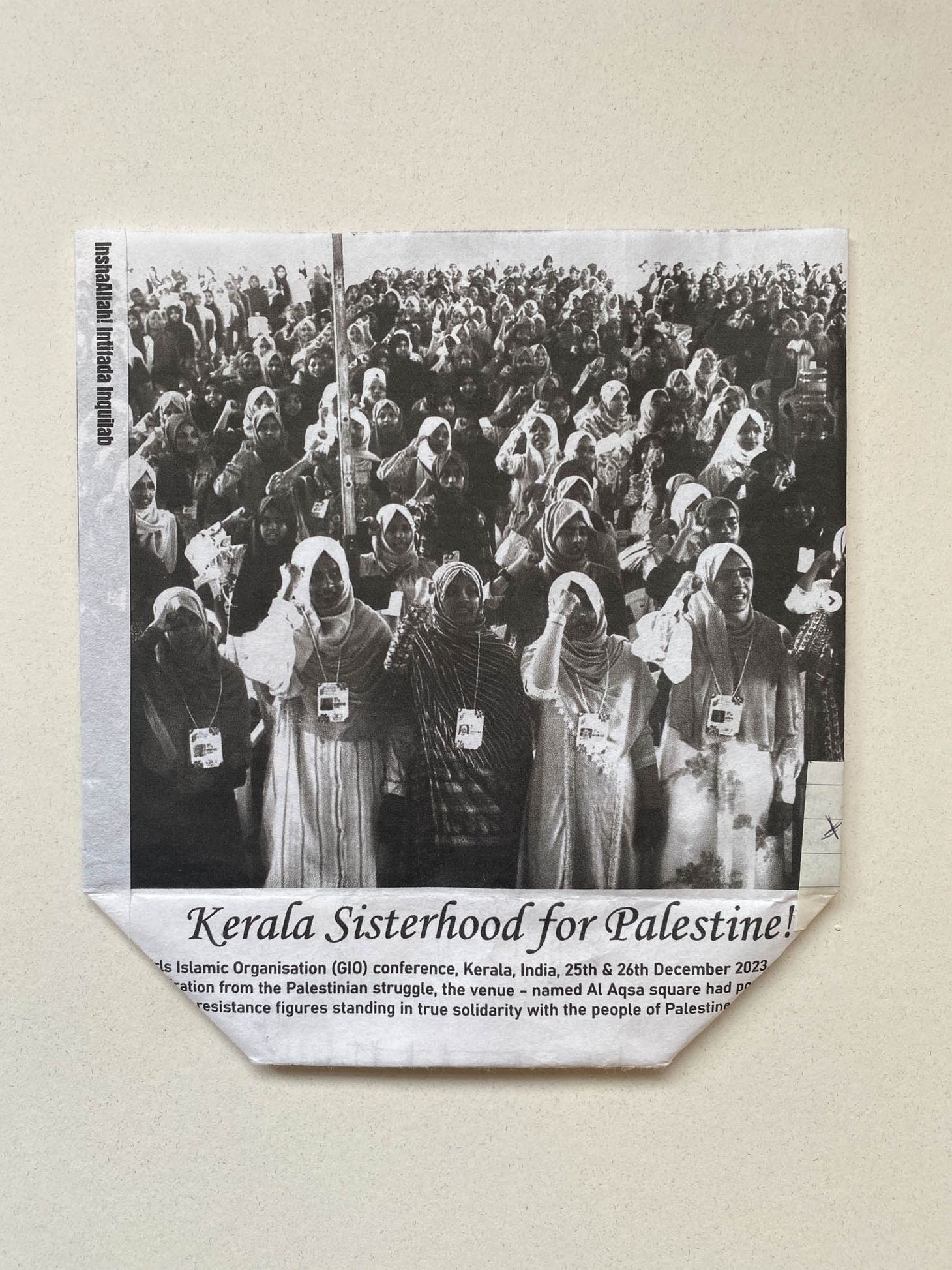
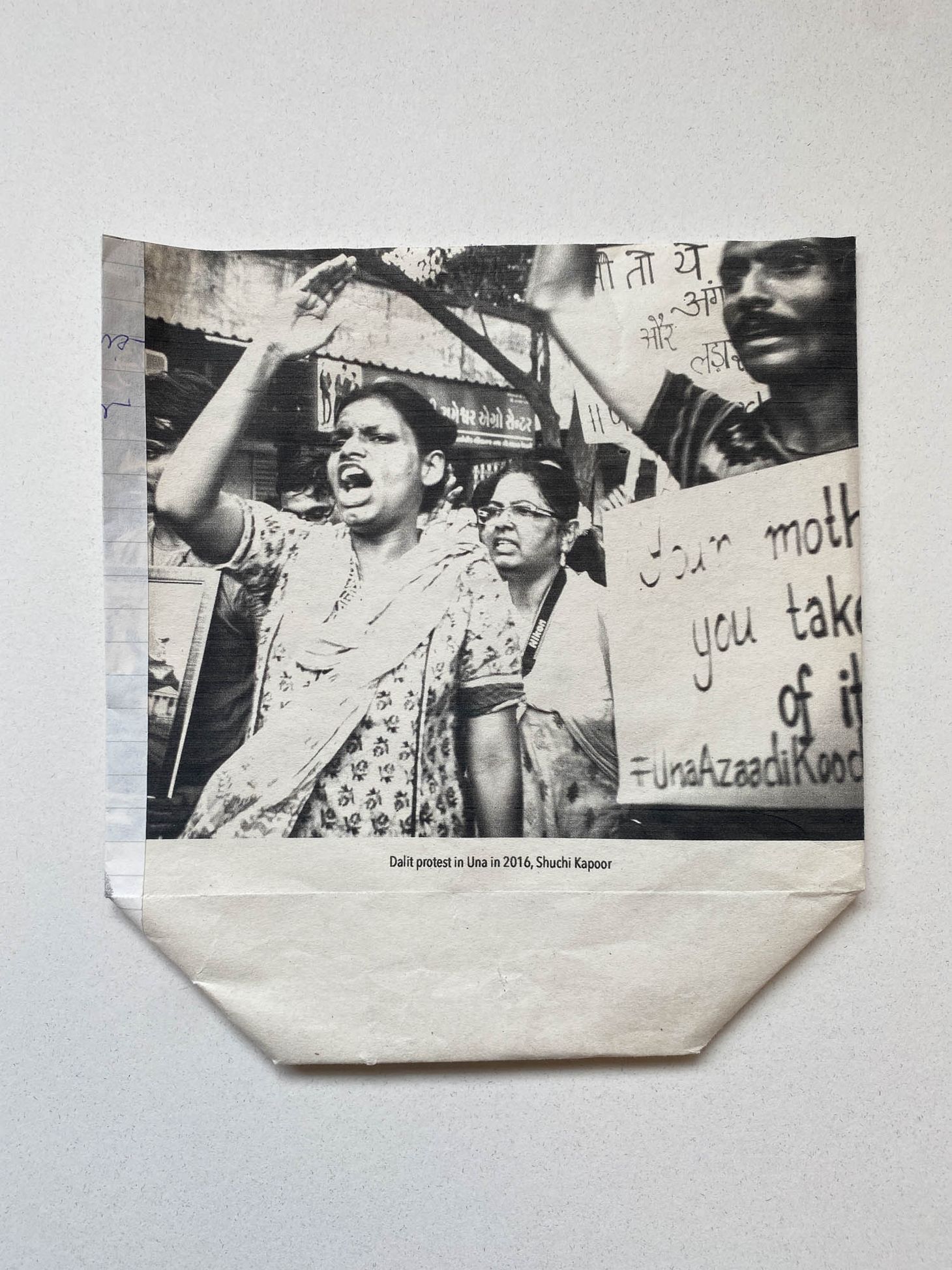
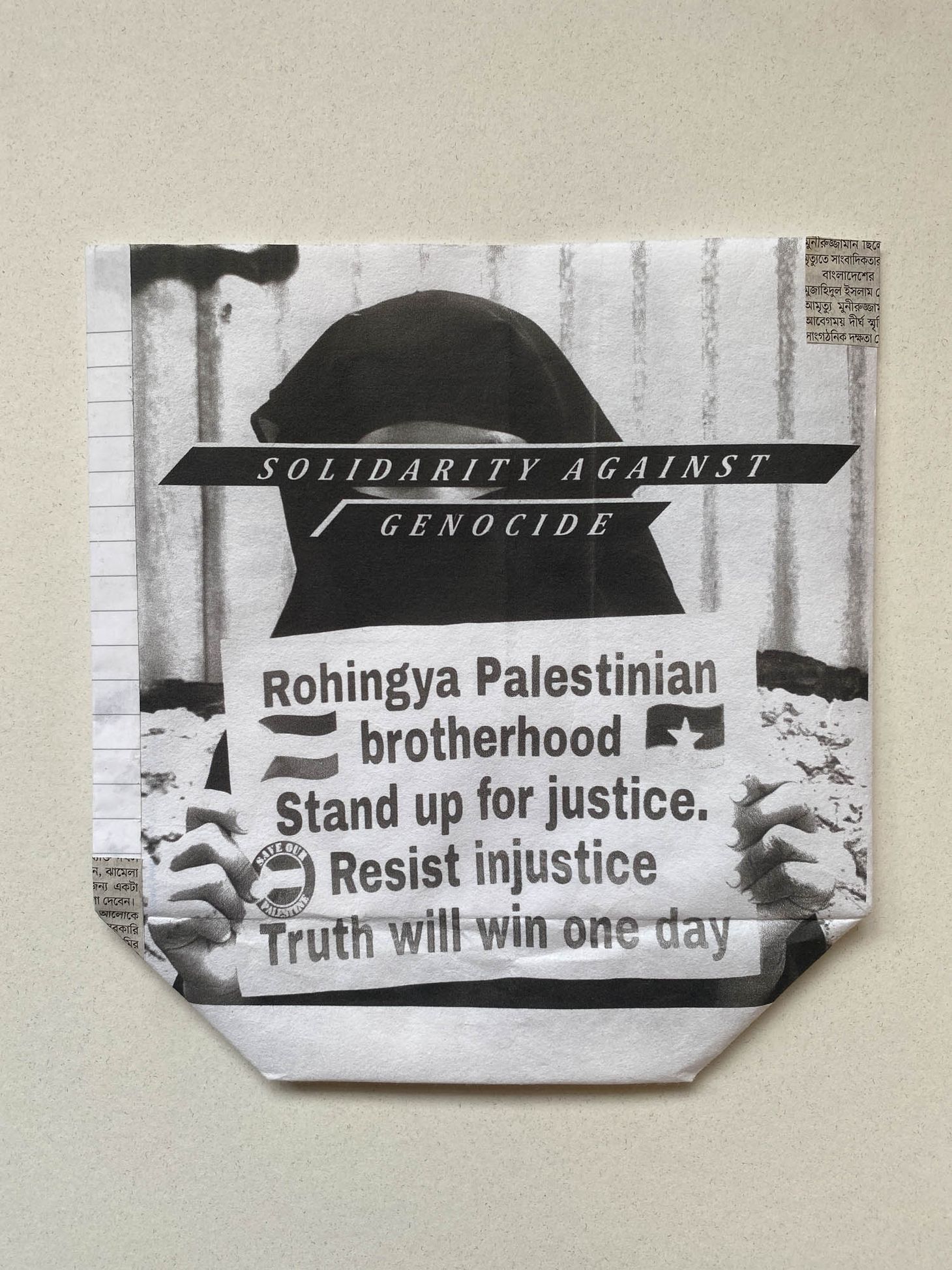
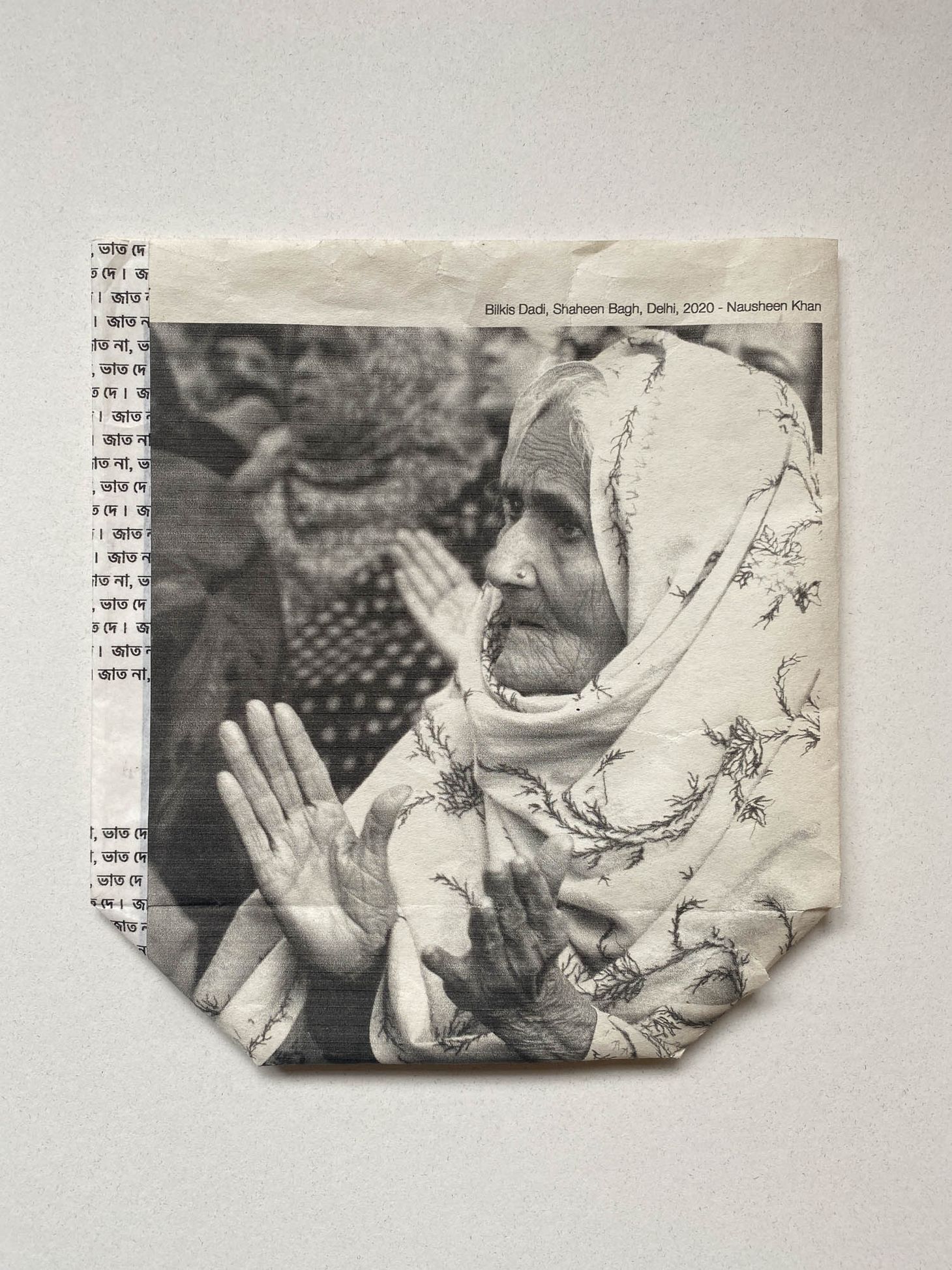
“Free Umar Khalid,” (details) samosa packet designed and made by Sofia Karim using photographs by Rohit Saha and Ronny Sen, part of the Turbine Bagh project by Sofia Karim, 2019-ongoing. Photograph: Sofia Karim. Made in 2020.
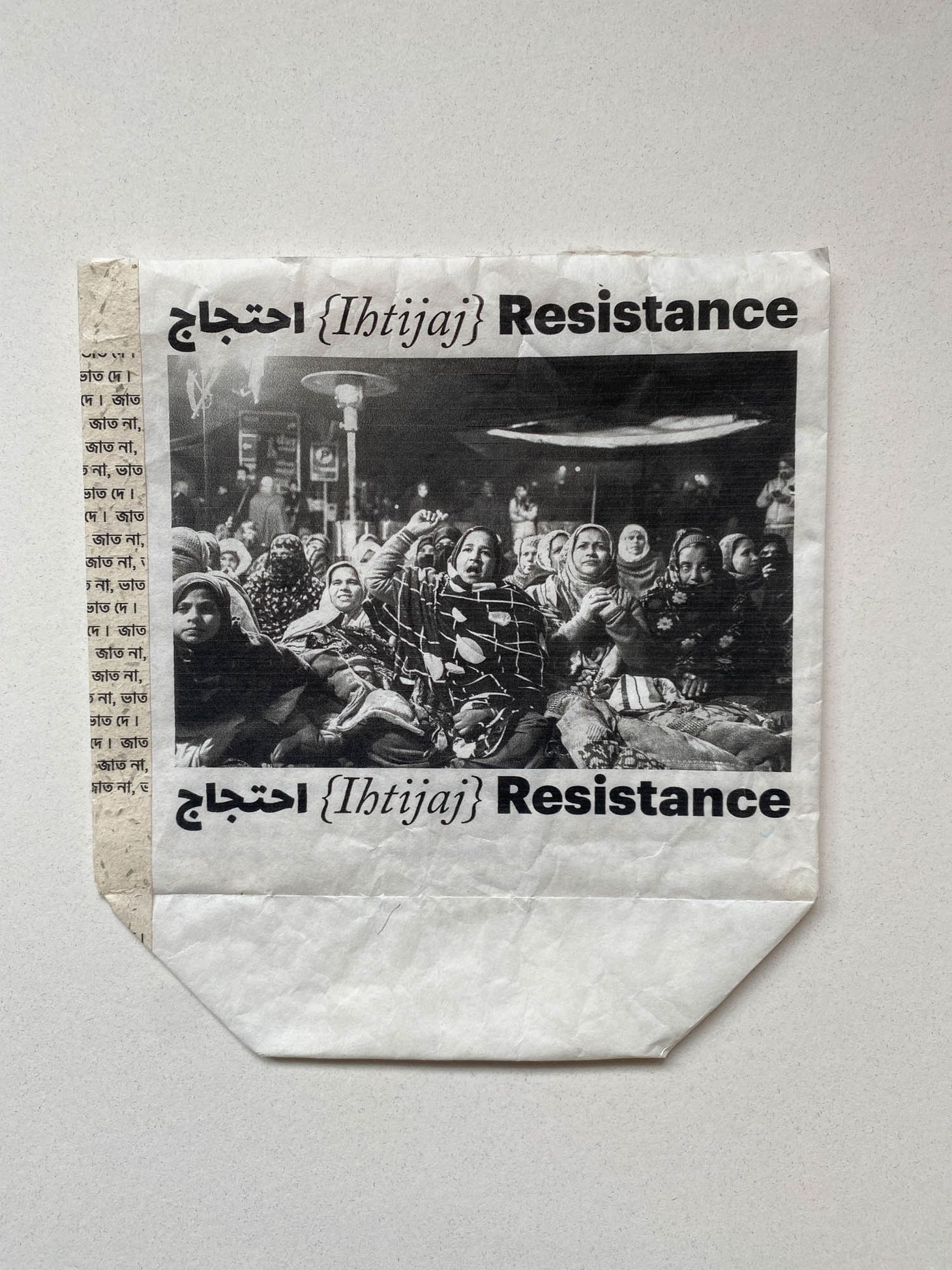
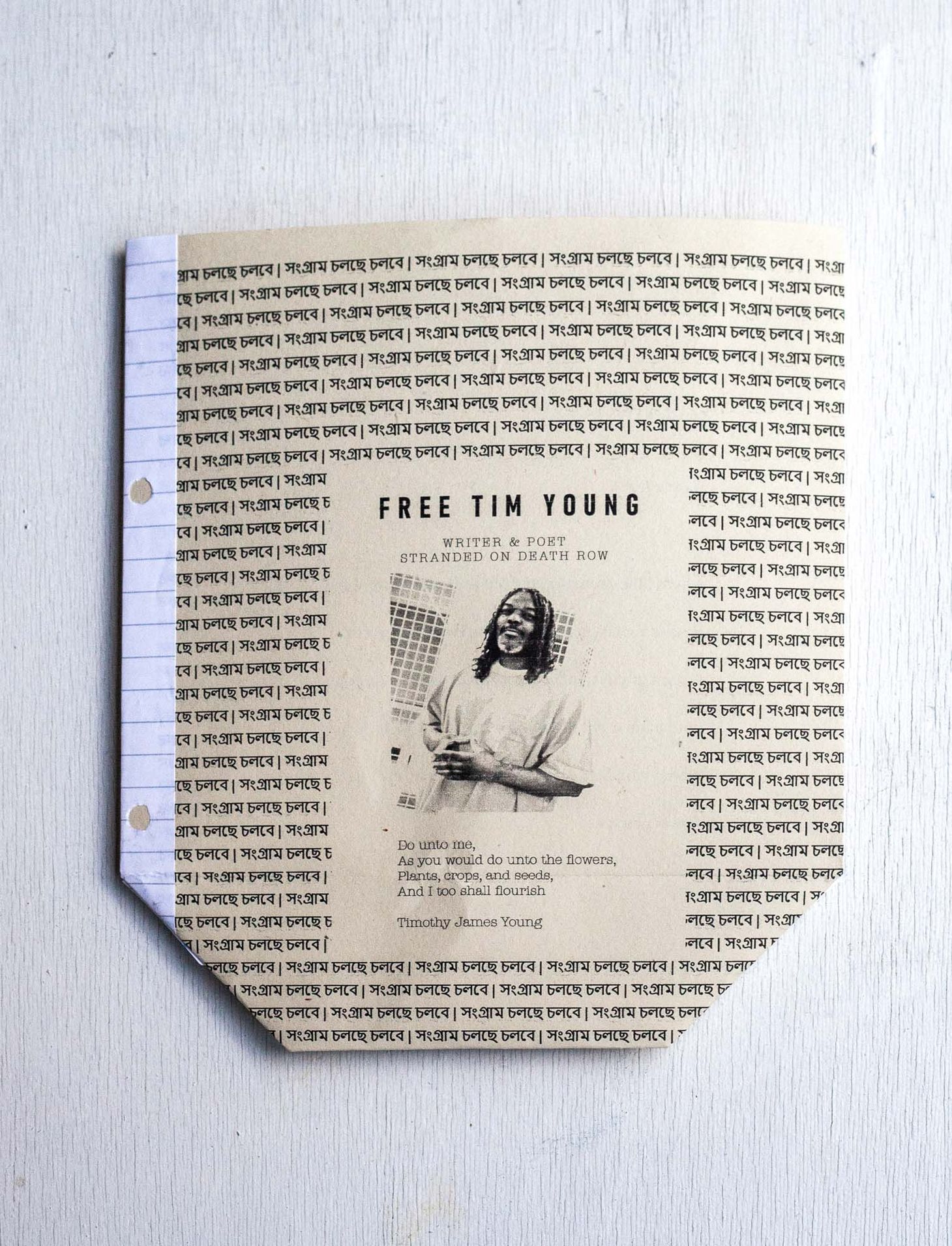
Turbine Bagh began as a protest planned for Tate Modern’s Turbine Hall in solidarity with Shaheen Bagh—the vast and historic resistance movement led by Muslim women in 2019, against the Indian government’s Citizenship Amendment Act. Using waste paper and her mother’s home printer in London, Karim worked with artists from around the world to create samosa packets (familiar objects across the streets of South Asia) for Shaheen Bagh. They have also been made for freedom campaigns for those imprisoned, including G. N. Saibaba, Anand Teltumbde and the BK-16, Umar Khalid, and Timothy James Young. Turbine Bagh samosa packets can now be found around the world; in prisons, on streets, in cathedrals, and in permanent collections.
The structures in which we work, live, pray, serve time, and die are inherent to Karim’s practice, which interrogates architecture “as a language of struggle and resistance” and often focuses on imprisonment. Below, a letter from Karim to Nasser Abu Srour, a Palestinian writer who served thirty-three years of a life sentence in Israeli prisons, accompanies images from Turbine Bagh.
3rd June 2026, London
Dear Nasser, Brother,
I am an architect based in London. Your work has had a profound impact on me and, in tribute, I am sending you these crimson letters. The letters are from the walls of a women’s prison in California, to you. I will explain.
My conversations with walls began naturally enough, when designing buildings. It has been well over two decades. They would speak, even before they came into being. The peak of the creative process would be when a wall would tell me what it wanted to be, how it wanted to describe space.
Then in 2018 my uncle, Bangladeshi photographer and activist Shahidul Alam, was jailed by the government of Bangladesh for 107 days, after reporting on student protests in an interview on Al Jazeera. My whole understanding of space shifted at this moment. During the days I would campaign constantly. But during the night I would dream about space. I began to dream about spaces I’d never seen before, comprised mainly of colour and some other indefinable quality which I can only describe as possibly emotion. Strange spaces, scaleless, expanding, contracting, expanding again. I wondered, What happens to space when you are blindfolded and confined, frightened? Is that what happens? I knew he had been tortured. I knew he was made to walk up and down stairs, blindfolded, with heavy objects on his head.
And then, as my aunt began to be allowed to visit him, I began to construct the prison compound in my head from fragments I heard about. I wanted to enter and be with him, if only to hold his hand. I hated the thought of him being alone. Now my conversations with walls began to change. In those morning hours of half sleep, I would ask the walls of his cell to tell me how he was. Each time, they would only reply in light and emotion—restless, not lucid, yet at its essence a language of love.
It was during Shahidul’s incarceration that I began a body of work titled An architecture of disappearance exploring architecture as a language of struggle and resistance. I began campaigning for other prisoners and have continued ever since.
It is still the case now and it was then, that when I’m most distressed it is architecture I find refuge in. It is really the only language I know, which is why, perhaps, it is the language in which I process things on both a conscious and subconscious level.
Last year, Hubert Murray, an architect from Design Palestine, told me about your memoir, The Tale of a Wall. (Design Palestine does projects with the Lajee Centre in the Aida Refugee Camp where you were born and grew up). I will never forget how I felt when I read it. This was the first time I had encountered someone articulating the language of walls, in the context of imprisonment, in artistic expression so elevated it transcends.
Last year I was invited by University of California Santa Cruz, Institute of the Arts and Sciences (IAS), to work with women in California prisons, as part of their Visualizing Abolition programme. They connected me to Stacey, incarcerated for over twenty-five years at Central California Women’s Facility (CCWF). “The colorless concrete and bricks feel like an empty tombstone waiting for me, waiting to claim me but I refuse.” —Stacey, letter to Sofia Karim, August, 2025.
Last month I began sending Stacey letters of light. They are letters from her wall to her. There are no written words. They are only plain white paper (in accordance with prison regulations), cut with slits. I sent them to her with this note:
Dear Stacey, my friend
In these pages you will find letters. They are letters from the wall that imprisons you. Letters responding to your letters. If you hold the pages up to the light, one over the other, the light begins to diffract through the slits. If the walls of your tomb could speak this is what they’d say. I am only the transcriber of these letters.
I do not forget you, comrade.
Blessings,
Sofia, 06 May 2026, London
And now her wall tells me it must also write to you, to say whatever it wants to say, but also as tribute for the gift of artistic exchange you have given me. Because surely your work has shaped mine and must be honoured as such. And so I enclose these crimson letters. Yesterday in a meeting with IAS, I showed them the crimson letters, and told them all this, and told them about you.
I don’t know what the wall is saying to you. I only pass on these crimson letters. If you hold the pages up to the light, one over the other, the light begins to diffract through the slits. They are for the torture and brutality you all endure in Israeli prison.
They are the blood of genocide and occupation. They are a testament to the fact that you have “never stopped apologising to Gaza and to the Palestinian prisoners” for your survival.
“for every thread of light that touches my face”
“for every breath I take”
“for all the space that has opened up to me” —Nasser Abu Srour, 20th May 2026.#
With the light of resistance.
In honour, Free Palestine,
Sofia Karim
- 1.
from “Why Don’t You Just Die?” by Nasser Abu Srour, transl. from the Arabic by Luke Leafgren.
↩︎

Sofia Karim
Sofia Karim’s practice combines architecture, visual art, and activism. The incarceration of her uncle—photographer and activist Shahidul Alam—led to the development of her theories on an “Architecture of Disappearance,” an ongoing project in which she explores architecture as a language of struggle and resistance. Her work has been exhibited at Tate Modern, the Victoria and Albert Museum, and the ICA, in London; the Rubin Museum, New York; Arthshila Ahmedebad, India); Museo Vivo del Muralismo, Mexico City; and as part of Documenta 15 (Steidl/ Kunsthaus Göttingen). She is the founder of Turbine Bagh, a joint artists’ movement against fascism and authoritarianism and platform for political art and activism. In November 2023 she set up Architects for Palestine / Tragic Turn, an initiative that raises funds for Gaza by offering architectural-design advice. She is now working on Free Tim Young / Tragic Turn, a collaborative art & architecture project with Tim Young, a wrongfully convicted prisoner on California’s death row. She is the 2025–2027 Visualizing Abolition artist-in-residence at UC Santa Cruz, creating work around women in California prisons. (updated 10/2026)