
Samira Abbassy, Threading Her Yellow (detail), 2025, collage and oil on canvas panel, 15 9/10 × 20 1/10 × 1 1/5 in
Chemical Hysterical
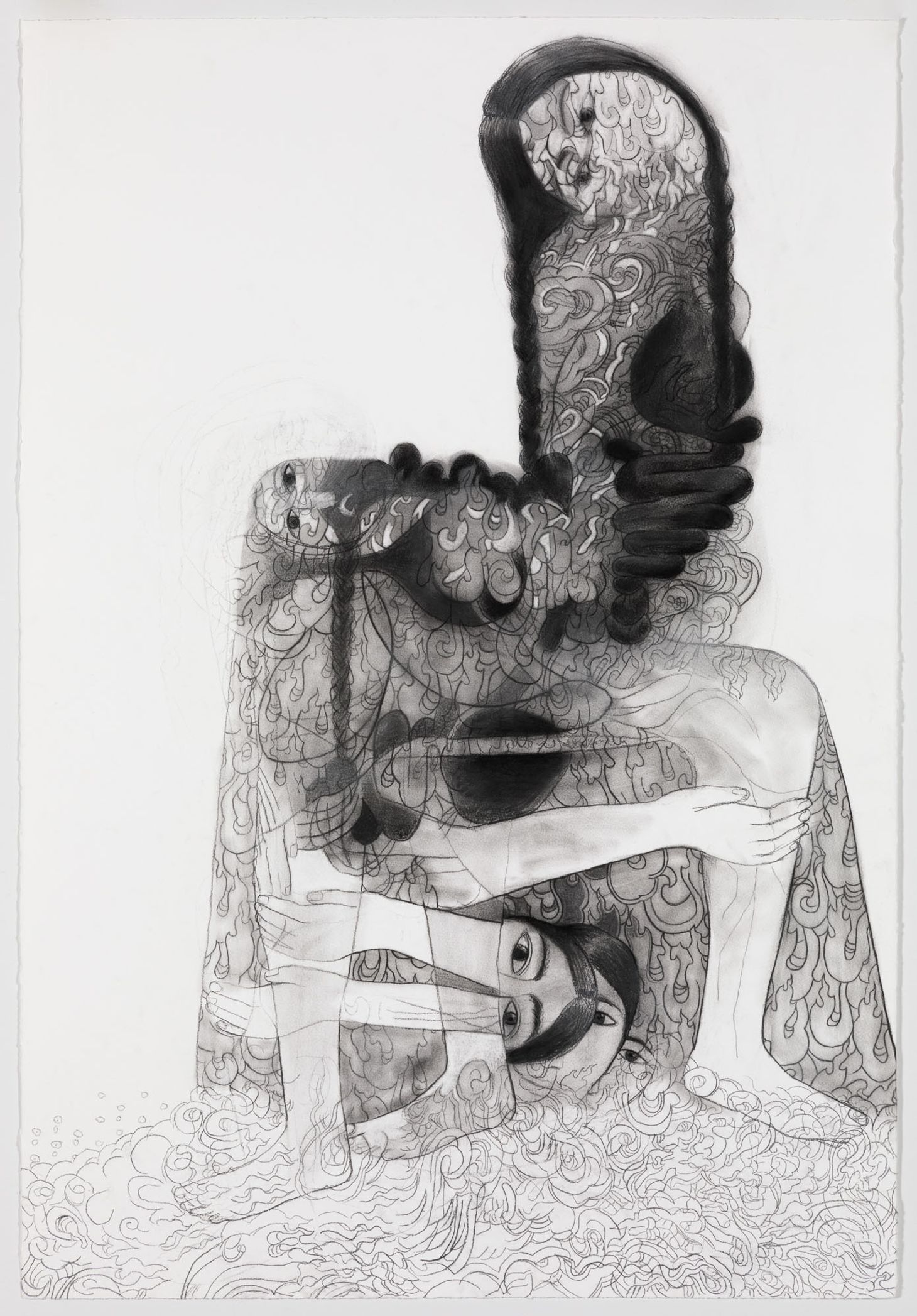
The women of Samira Abbassy’s Chemical Hysterical series are, in a single word, indeterminate. Anatomical accuracy is subverted in favor of bodies which intentionally fail to hold themselves together. Framed by the winding lines of language, hair, dress, and the female body, a figure emerges from delicate layers of charcoal dust with a gentle violence: not as any specific individual, but as a fragmented assemblage of experience present and ancestral. In making, or perhaps “mixing” images—tracing, enlarging, overlaying a vital part of her process—she uses “the overhead projector almost as a turntable: sampling images, layering them, and allowing one fragment to trigger another.” It’s apt, then, that the title of the series emerged from a lyric of Radiohead’s OK Computer.
Abbassy began the series in 2006, a year which saw elections, executions, and natural disasters: in other words, a year like any other. With the calm that emerges from a sense of history as unfixed and reaching in all directions, she draws inspiration from the art and ideas that shaped epochs: Hindu iconography, Elizabethan garments, Jung, The Inferno, Qajar court painting. This is perhaps a result of her own cross-cultural upbringing—the artist defines herself as an Iranian Arab, grew up in the UK, and now lives in New York City. Her kaleidoscopic curiosity reveals a figure which carries inside of it the near-magical intangible: the bodies we have tried and failed to define throughout history, the consciousness that comes in multiples, the vastness of mythology, even the matter that we cannot hold. In Abbassy’s alphabet are feminine, winding threads of her own lineage. The hair of her grandmother appears in vine-like plaits. Arabic and Farsi fade into new forms of language, which the artist calls “psychic clothing.” Faces and hands gaze and reach towards an array of simultaneous truths. Ultimately, the artist summons the female self as a mythological, time-traveling home for all we fail to define.
Samira Abbassy on Chemical Hysterical
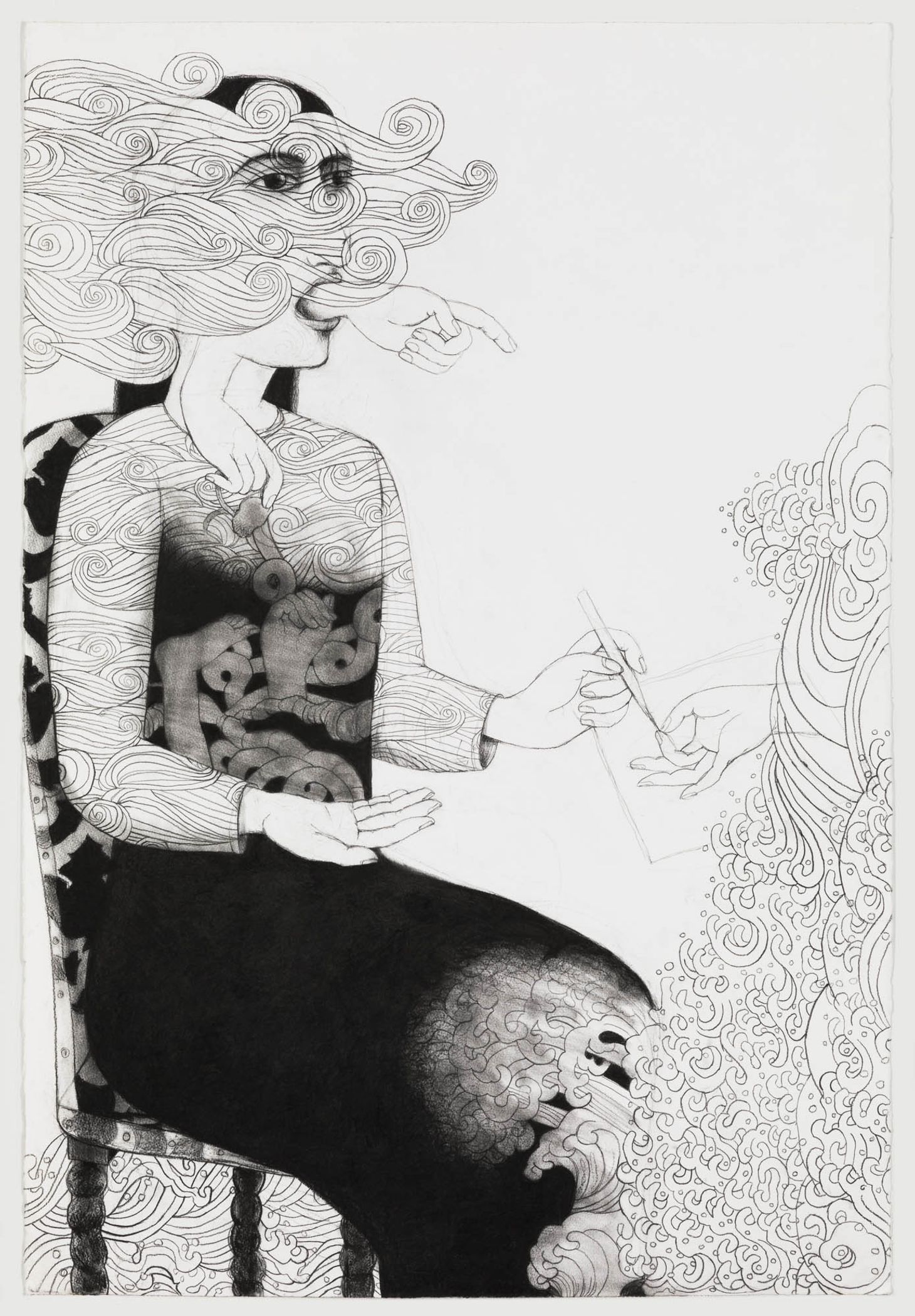
“A chemical reaction / Hysterical and useless.” I was drawn to the phrase because it offers a deliberately pseudo-scientific description of emotional experience—as if states of anxiety, desire, grief, memory, or transformation could be understood simply as chemical and hormonal events triggered by neurons. The phrase collapses the distinction between the psychological and the physical. It suggests the body as a biochemical system while also acknowledging the mystery of what cannot be reduced to chemistry.
The anatomical figure at the core of the Chemical Hysterical series is derived from medical illustrations in a Persian medical manuscript dating from the medieval period, held in the Ahmadiyyah Library in Aleppo, Syria. These images belong to the Galenic medical tradition, in which anatomy was understood within a larger philosophical and cosmological system. I have always been struck by the fact that these drawings, although ostensibly diagrams of the body, seem to reach beyond the biological. They appear to be attempts not only to make sense of the physical body, but to locate something within it that cannot be seen: the soul, consciousness, or life force.
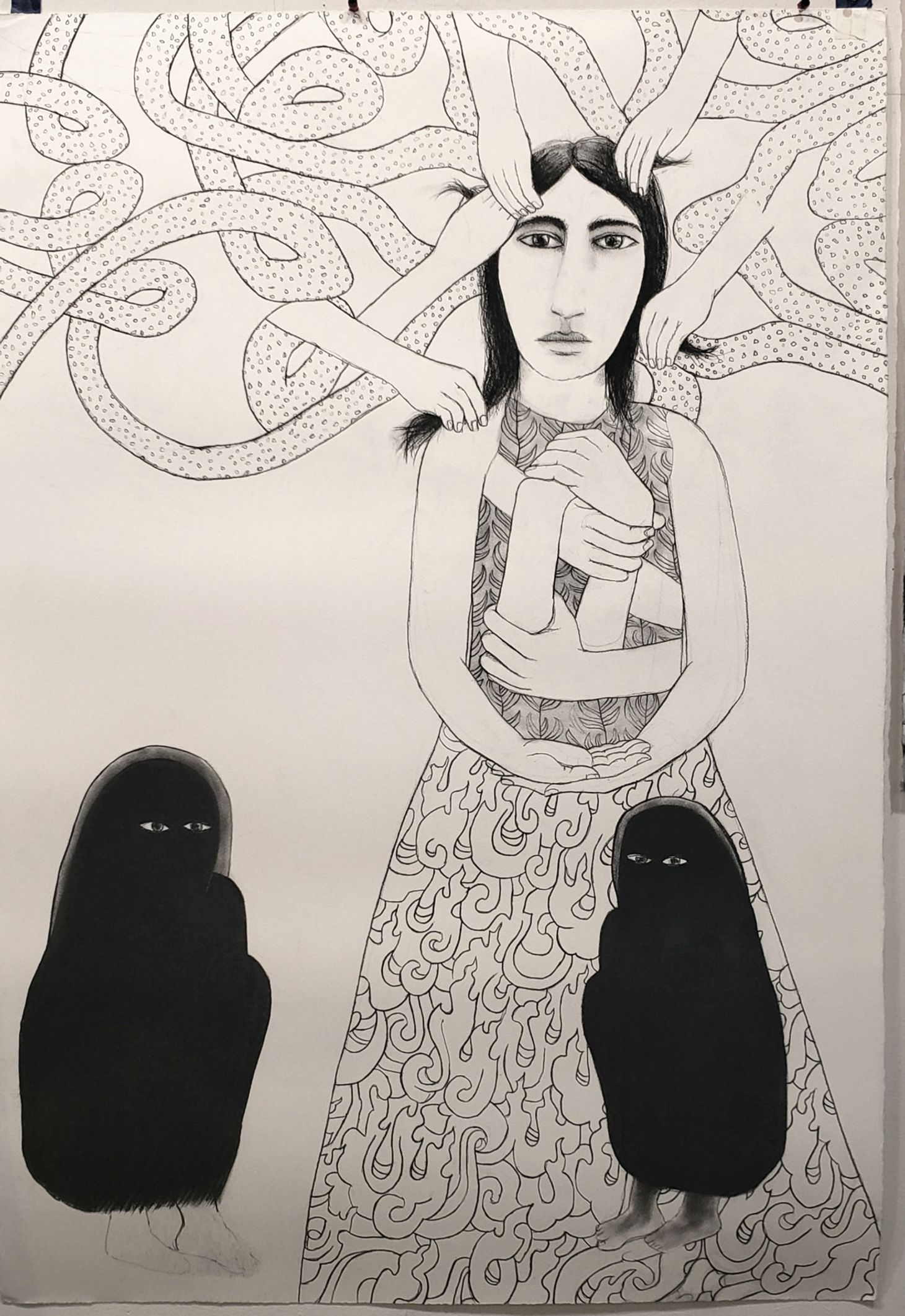
This fluctuating representation has a mirror in modern physics, which has challenged the notion of matter as fixed and entirely material; through this perspective, a world of particles, waves, fields, probability, and constant transformation evades a stoic shape. The medieval anatomical image and the contemporary scientific image therefore meet in a shared question: Where, within the material body, might the intangible reside?
This semi-legible anatomical body is then dressed. The garments are not simply decorative; they articulate what the body cannot. I think of them in relation to the embroidered garments of Elizabeth I, whose clothing could function as a map of power, territory, identity, and self-invention. In my figures, patterns and embroidery similarly become a kind of psychic and cultural cartography. The body is clothed in its history.
Language is another layer of this psychic clothing. As an Iranian Arab, Arabic was my first language, followed by Farsi and then English. The successive overlaying of languages created a distance between myself and my original cultural environment. Arabic and Persian calligraphy therefore enters the drawings both as a cultural signifier and as a meditation on the instability of meaning. At times the writing is deliberately illegible, dissolving into pattern. It suggests language before it has fully formed into thought: fragments of memory, internal monologue, half-articulated feelings, and meanings that have been lost or displaced through translation. In some works, the deconstructed lines of Arabic and Farsi are echoed in renderings of unravelling braids, which evoke the hair of my maternal grandmother while also suggesting genetic and umbilical links. The tension of hair in these works holds together the impulses toward connection and separation, inheritance and loss.
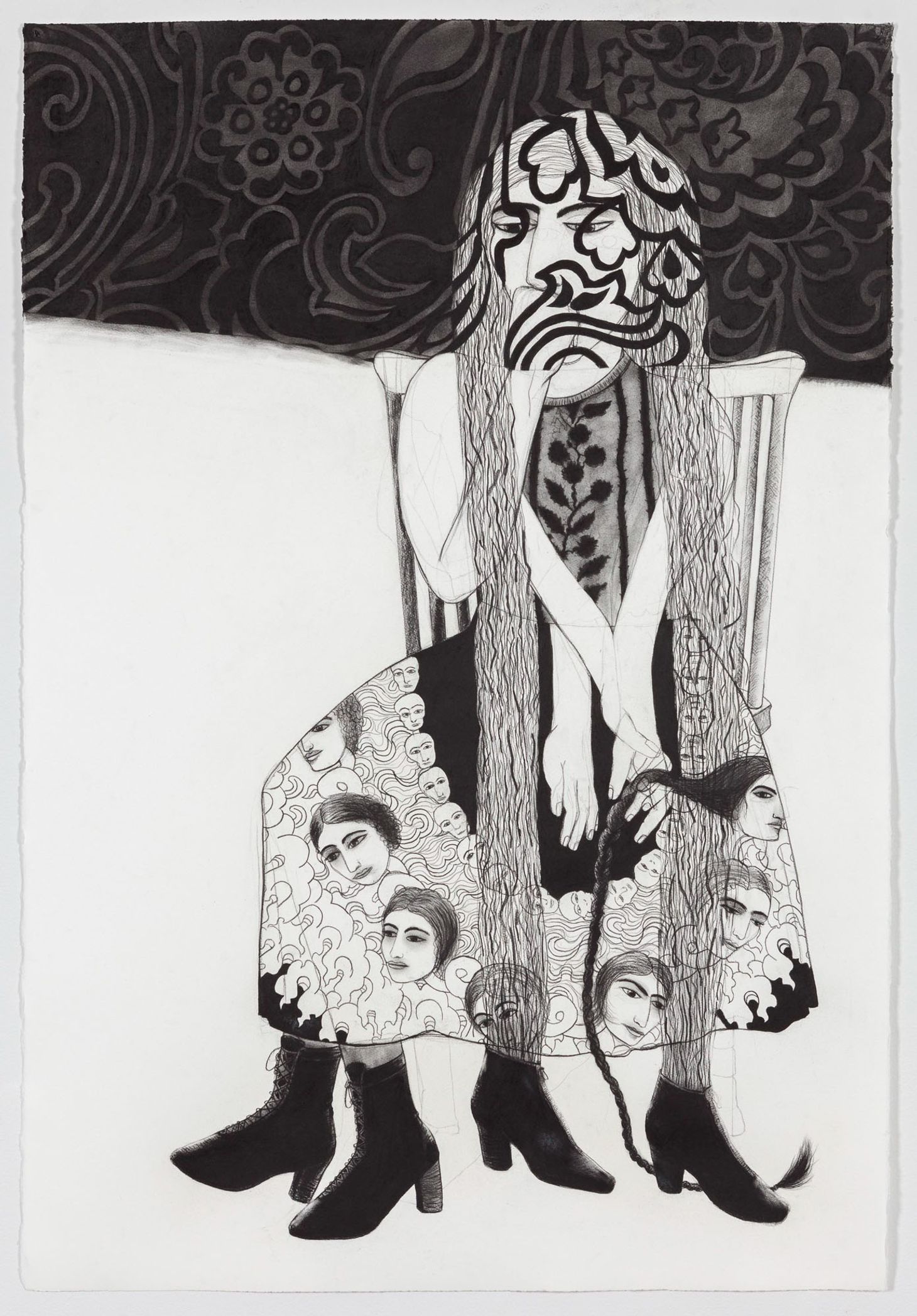
These drawings are constructed through a process of fragmentation and recombination. I use an overhead projector to create virtual collages from fragments of my own photographs and drawings alongside borrowed images from historical, scientific, medical, and cultural sources. I move these fragments across one another, enlarging, reducing, overlapping, and recombining them until a new figure emerges. The process has an affinity with the Surrealists’ exquisite-corpse approach, in which independent fragments are brought together to generate an unexpected whole.
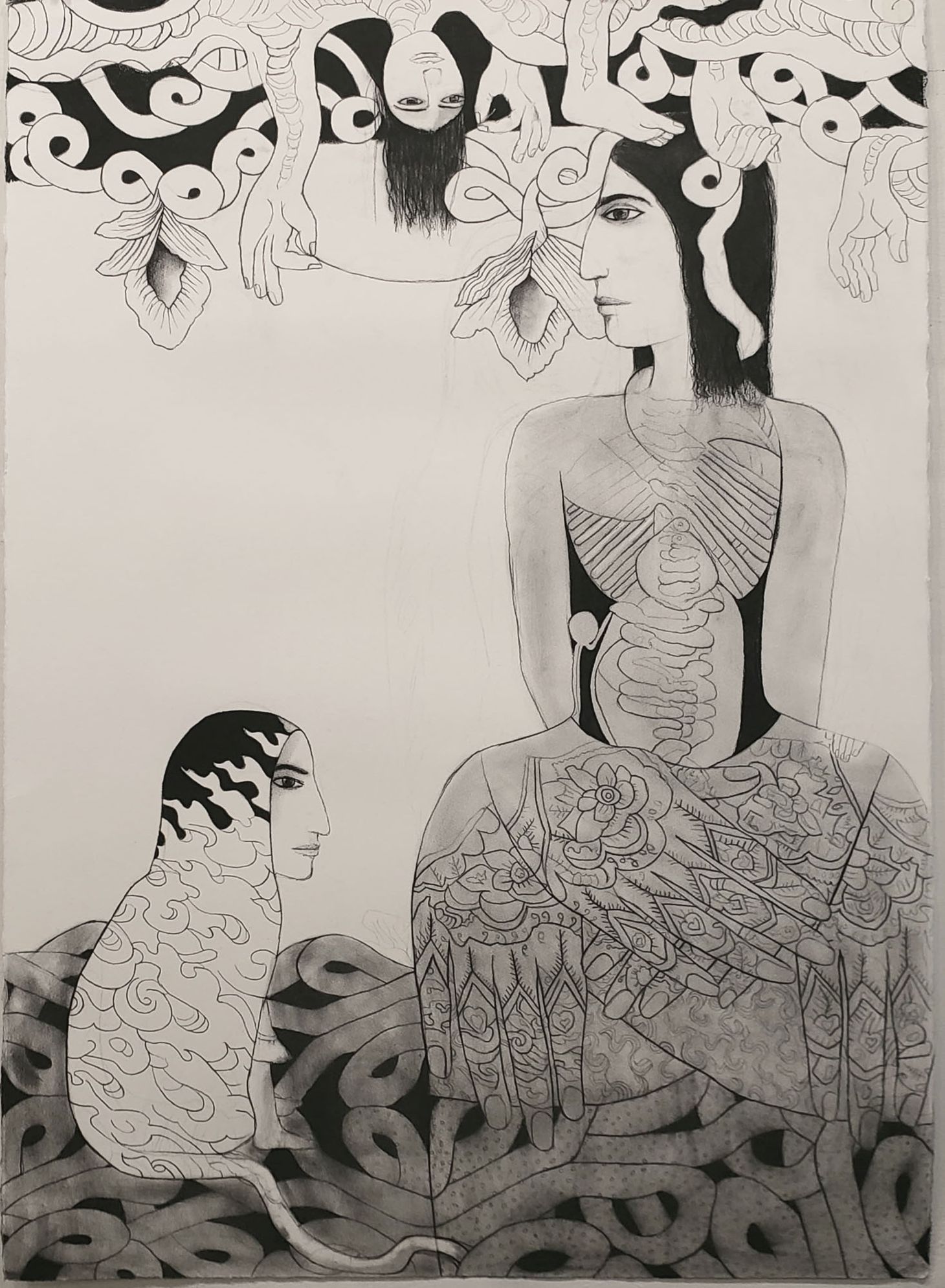
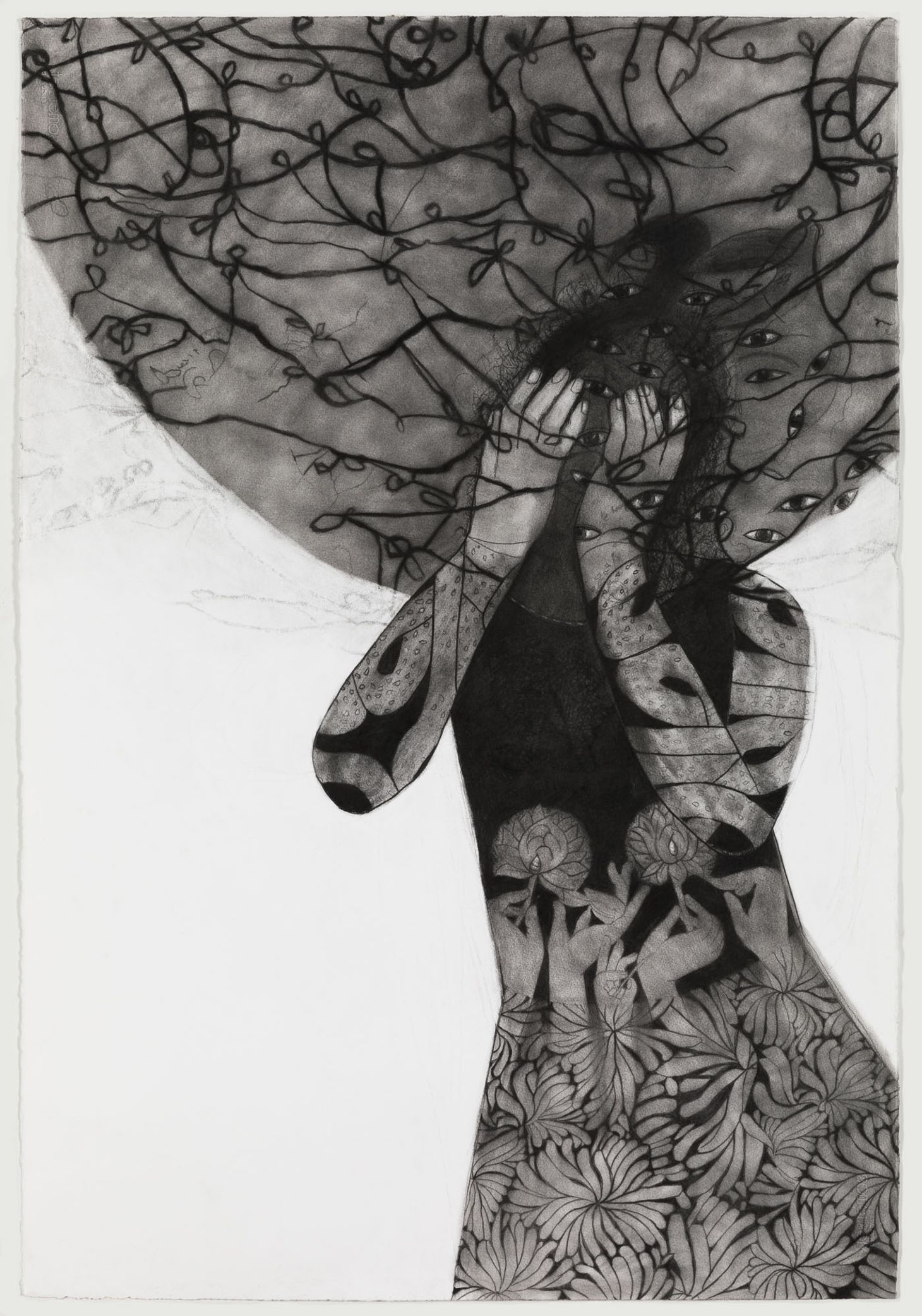
This method of making is itself a metaphor for the work. What initially appears to be a single body contains multiple histories and states of being. Charcoal is particularly suited to this investigation, as its materiality allows the figure to emerge and disappear simultaneously. The dense blackness of the charcoal can become flesh, shadow, hair, writing, or void. The body is never entirely stable. It is continually being formed, erased, obscured, and revealed.
The Chemical Hysterical drawings ultimately ask what it means to inhabit a body while knowing that the body can never fully explain the self. Beneath the visible body is another body—emotional, ancestral, cultural, and psychic. The drawings are attempts to make that invisible body visible: to locate, within the physical and the material, the intangible thing that continues to elude definition.

Samira Abbassy
Samira Abbassy was born in Ahwaz, Iran, in 1965 and moved to London, U.K., as a child. After graduating from Canterbury College of Art, she began showing in London. She moved to New York in 1998 in order to establish and cofound the Elizabeth Foundation for the Arts and the EFA Studio Center in midtown Manhattan. In a career that has spanned more than thirty years, she has had more than twenty solo shows in London, Dubai, and New York. Her work has also been included in shows at The Metrolitan Museum of Art and The British Museum, and is in their collections as well as other private and public collections worldwide, including at the British Government Art Collection; the Grey Art Gallery at New York University; the Burger Collection; the Donald Rubin collection (Rubin Museum, N.Y.); The Farjam Collection, Dubai; the Los Angeles County Museum of Art; and the Afkhami Collection. (updated 10/2026)