
Danielle Mckinney, Mercy (detail), featured in AGNI 103
To plan a route to pick up my child from school, I check iceout.org for a map of recent ICE sightings. They’ve multiplied in recent days, with the Federal occupation surging to 3,000 agents in Minneapolis, five times the size of the city’s police department. Earlier in the morning, an unconfirmed convoy was sighted near the Spanish-language immersion daycare two blocks from my home, and another patrolled four blocks west, near a restaurant where my choka works the dinner shift. I fold a copy of my naturalization certificate and zip up my coat pocket. My cell phone is charged. My gas tank’s almost empty, but I can make it if I fill up at the station on Lyndale, where there hasn’t yet been a sighting—at least not today.
Not every day is like this one. Some feel so humdrum, as I putz around my apartment, that I question my vigilance. Others are pierced by whistles and sirens. I no longer look outside or answer the door. (My landlord kindly taped up private property signs, downloadable at the City of Minneapolis website.) Then on January 24th, as I was on the phone with AGNI editor Bill Pierce, the drone of helicopters interrupted us, and text messages pinged: Are you ok? Where are you? Ice killed again.
The works gathered here constitute acts of witness from Minneapolis, 2026. They pull apart and lay bare the historical and embodied dimensions of carceral Trumpism by making sense of its full-scale assault on personhood and daily life. As Lau Malaver writes, “The border, then, is not outside us. It moves through us.” Fascism first attacks our senses, then moves through our imaginations, in its bid to normalize causeless maps of search and seizure. Our government is detaining and disappearing our neighbors. May these writers remind us all of our individual power to refuse this death-dealing cartography and to imagine one another whole and free.
Jaden Janak
Live from Occupied Minneapolis
January 28, 2026
The Federal government has occupied Minneapolis and the greater Twin Cities area for the past fifty-six days and counting. Operation Metro Surge, the Federal takeover of Minnesota, has resulted in thousands of arrests and detainments, and the mass brutalization of neighbors. Earlier this month, an ICE agent murdered Renee Nicole Good in broad daylight, just a few blocks from George Floyd Square—the location of George Floyd’s murder and the subsequent autonomous zone created for mutual aid, organizing, and communal resistance. A week later, a Federal officer shot and wounded Julio Cesar Sosa-Celis, an immigrant from Venezuela. Last weekend, agents brutally beat and subsequently murdered Alex Pretti in my neighborhood. The indiscriminate deployment of chemical warfare against observers by Federal, state, and local law enforcement and the wanton disregard of the illusory U.S. legal framework has left many feeling justifiably terrified.
In the midst of this horror, community members have mobilized much like they did after the murders of Amir Locke, George Floyd, Philando Castile, and Jamar Clark (to name a few). Some are delivering meals to neighbors who are afraid to leave their houses; others, like Powwow Grounds and Smitten Kitten, are hosting donation drives at their businesses. There is a robust and coordinated response across neighborhoods to meet the needs of those most in danger. As the Federal government sends in reinforcements, Minneapolitans keep showing up en masse to refuse the siege and affirm our collective right to life and safety.
Those who do not live here keep asking why mass resistance and liberation movements begin in Minneapolis. They wonder what it is about this space and place that lays bare the central contradictions of our country and elicits such widespread response from the people. Many know Minneapolis as the site where the American Indian Movement began in 1968. Others might know Minneapolis as the place where CeCe McDonald, a Black trans college student, was attacked by a white supremacist group and ultimately prosecuted for defending herself. A few may know that George Floyd’s murder illuminated the Minnesota Paradox—that despite its reputation for progressivism, Minnesota is home to some of the worst disparities for Black people in the U.S. But to really understand Minneapolis and Minnesota, we need to adopt a much wider historical lens.
The occupation of Mni Sota Makoce did not begin with ICE or the Border Patrol but rather with the infiltration of French fur traders in the mid-1600s. The French brought disease and knew little about the area, so they relied heavily on Dakota and Ojibwe epistemologies to survive. In 1680, Louis Hennepin, a Franciscan friar, came to Mni Sota Makoce to evangelize the indigenous populations and “locate” the Mississippi River. He founded a Catholic mission and was swiftly captured by the Dakota. While being held, Hennepin saw and named the only natural falls on the Mississippi River. Already known as Owámniyomni (Dakota) or Kakabika (Ojibwe), the falls became the St. Anthony Falls, somewhat ironically named for the Franciscan saint of lost items. For the Dakota, Owamniyomni is sacred land. It is connected to Bdote—the meeting place of the Minnesota and Mississippi Rivers and the center of one of the Dakota creation stories. French settlers remained the majority of the settler population until the mid-1700s, when the British took over the fur-trading posts and began expanding their colonial footprint.
In the early 1800s, white settlers sought to establish a military fort and trading post at Bdote.Lieutenant Zebulon Pike negotiated a treaty with the Dakota people to build what would become Historic Fort Snelling. Pike paid the Dakota only ten percent of the land’s value. The U.S. president did not approve Lieutenant Pike’s land expedition and, thus, Pike did not have legal standing to represent the government’s interests. But then as now, the illegality of Federal agents’ actions did not faze the state actors. After a few years of construction, Fort Snelling opened in 1825. Throughout its first decade, military personnel and fur traders relied extensively on the labor of enslaved Africans. The practice of enslavement was illegal in the land that would become Minnesota, but slavery continued nonetheless. Dozens of enslaved people lived, loved, and labored at Fort Snelling, including Harriet Robison and Dred Scott. They met and were eventually married there. Inspired by a successful freedom case filed in Missouri—the plaintiff was Rachel, an enslaved woman held captive at Fort Snelling—the Scotts sued for their own freedom. As we know, their 1857 case (Scott v. Sanford)went to the Supreme Court, which ultimately found that Black people were not people at all and therefore had none of the rights afforded to citizens. The next year, Minnesota became a state. After the Dakota Uprising of 1862, Fort Snelling was the site of the mass execution of Dakota freedom fighters and then became an internment camp used to imprison Dakota women, children, and elderly people.
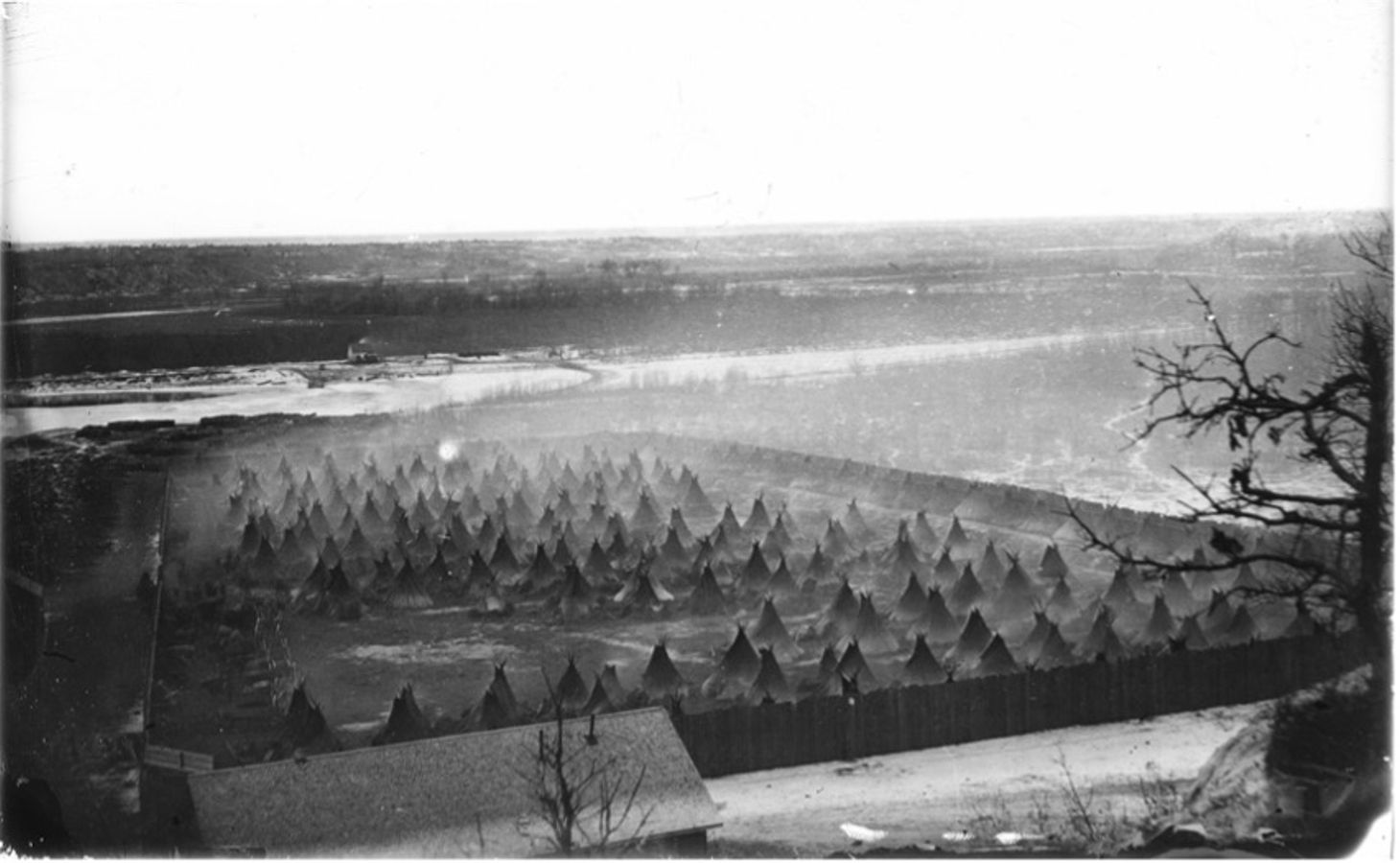
These horrific tales of colonization, forced migration, enslavement, and state violence are not an aberration. The truth is that this land has been occupied for hundreds of years. First it was the French, then the British, and after them, Swedish and Lutheran Norwegian settlers who opened colleges. The land of Mni Sota Makoce has also been occupied by carceral institutions and their authorities. In 1853, more than a decade before Minnesota became a state, the territory opened its first prison (now Minnesota Correctional Facility–Stillwater). Minneapolis itself has been occupied by the Minneapolis Police since 1867. It would be a critical error to assume that the violence we are facing right now is exceptional or ahistorical. The anti-Black and anti-indigenous violence of this country and this state is intimately woven into the fabric of this moment. The occupying force has changed. Its members increasingly representative of a rainbow coalition of imperialism. But the logics undergirding the invasion and occupation are the same now as always. For example, Historic Fort Snelling is part of the unincorporated territory of Fort Snelling, the larger swath of land that now houses the Bishop Henry Whipple Building, where ICE has been terrorizing protesters and locking up our neighbors, including Indigenous ones. The goal of these regimes remains land and resource acquisition through a campaign of terror aimed at eliminating undesirable populations.
This moment again makes clear that our foundational institutions cannot save us from settler colonialism. The country’s legal apparatus is part of that project, not the solution to it. ICE—closer to slave catchers than gestapo agents—do not care if one has the “proper” documentation from the imperial core. The State of Minnesota does not care that ICE is not “allowed” to bust in people’s homes, cars, and workplaces without a warrant. Invoking one’s Constitutional rights does not stop bullets to the head. Many of us have been manipulated into believing that voting for “progressive” politicians will ensure our safety, or at least make our lives a little more livable. But as we see so clearly now, our government officials have nothing to offer us beyond thoughts and prayers, with the occasional admonishment to remain peaceful as tear gas fills our lungs.
As a scholar of Black social movements and policing, I am reminded that we desperately need more community-driven interventions that expressly respond to the interlocking nature of interpersonal, communal, state, and colonial violence. Some have suggested that eradicating ICE might bring an end to the wanton violence of immigration enforcement. The elimination of ICE, an agency less than thirty years old, would bring momentary relief for some. But if we understand ICE, the imposition of borders, and policing as part of a wider strategy for mass elimination, then merely shutting down the agency will not bring an end to the violence it begets.
My research and organizing work focus on prison abolition—a school of thought and practice aimed at dismantling the widespread network of systemic violence (often referred to as the prison industrial complex) that produces differential life chances for different groups of people, and developing a collective capacity to imagine and build a world beyond policing. After the murder of George Floyd in 2020, Minneapolis organizers pushed for the abolition of the Minneapolis Police Department. They gained initial support from the city council and placed the words “defund” on the tongues of people around the world. That summer, the Movement for Black Lives released a federal proposal for abolition in 2020 known as the BREATHE Act, which sought to implement abolitionist principles on a national scale. As we know, the proposal to defund the Minneapolis Police Department was eventually defeated. More money goes to policing in Minneapolis now than it did in 2020. The BREATHE Act did not make it past the point of being introduced. If it had been ratified, ICE would not exist and neither would federal prisons. The defense budget would be slashed and in its wake, healthcare and a social welfare net provided. If the Minneapolis Police Department had been defunded, we would have better funded infrastructure to support unhoused people, education, and collective flourishing. Though these interventions were defeated, they did not fail. They opened a new paradigm for reconsidering the permanence of policing and prisons. These interventions show us that abolition should be the floor, not the ceiling, of our imaginations for a better world. To overcome social problems, we need more bold, brave communal solutions that do not involve law enforcement or policing of other kinds. This is life or death work.
Over the past several weeks, I have seen glimpses of what safe communities can look like. Tens of thousands have packed the streets to express their righteous discontent. After the murder of Good, I attended a protest in Powerhorn Park, near the site of her murder. There, I saw signs connecting the dubious history of U.S. policing with the genocide in Palestine and the U.S. takeover of Venezuela. I heard sirens drowned out by the dulcet ring of jingle dresses. I witnessed neighbors who know American Sign Language walking through the crowd and interpreting for those who are deaf or hard of hearing. Even as conditions seem to be increasingly getting worse, I’ve watched proudly as my neighbors, armed with whistles, bright vests, and gumption, face off against heavily armed militia—and win! There have been multiple calls for work stoppages, the most recent of which, on January 23rd, led thousands to go on strike and hundreds of businesses to close. In this time of great fear and aggression, we’re seeing the truest definition of comradeship play out across the metro area. Every skillset is necessary in this moment. The trans anarchist hackers are just as important as the indigenous elder leading the dance.
I don’t know how long this siege will last. I pray it ends soon. But when it’s over, the occupying army will move to a new location and start again. To have any chance of surviving this moment and the ones to follow, we need one another. This is a time for community, not isolation. Any modicum of safety we might have, we have because of communal resistance. We owe it to one another to overcome this occupation by first attending to the long history of occupational violence that precedes it.
A luta continua.
Lau Malaver
Recovecos under Siege
January 28, 2026
Handwritten and printed signs are strung from my neighbors’ balconies, taped to their windows, propped against radiators. “ICE Out!” “Fuck ICE!” “ICE Is Not Welcome Here!” It feels hard to get up from bed these days. My routine begins with a few seconds of gratitude, followed almost immediately by a jolt. My body tightens. My chest constricts. My throat interrupts speech before it forms. I wonder what happened while I slept, and what is newly in motion.
I reach for my phone. I scroll: group chats, social media, emergency threads. More abductions. Another protester shot. Many injured. Some denied care. Everyone under siege. I sit comfortable but alert in my living room. On my reading chair there’s a sign like the ones outside: “I.C.E. Out of Minneapolis.” This is the present tense of my block, my neighborhood, my city.
I come to this moment through what I call recovecos: the nooks, twists, folds, and recesses of lived experience that open in the cracks of empire. Recovecos are not only physical spaces but epistemic and affective turns: the hidden curvatures of survival where the modern surveillance machine loses its line of sight. They are alleyways and living rooms; church basements and back hallways; bodies curled on couches unable, yet, to rise. They are the intimate corridors where life is sustained under siege.
When you’re a person othered as a “minority” (in my case Latino) and you’re living within American empire, “Migra!” is not simply a warning cry. It is a theory of the nation condensed into a word. As Kelly Lytle Hernández writes in Migra! A History of the U.S. Border Patrol, migra names a mobile institution of racial governance: one that reveals the border not as a static line, but as a method that moves wherever agents patrol, question, and detain. The border appears inland, in neighborhoods like mine, because the target is not a geography of stolen land, but a population continually rendered deportable. The cry “Migra!” trains the senses. It emphasizes the truth of racialization: some bodies belong without question; others must prove belonging on demand. Border Patrol, founded in 1924, and Immigration and Customs Enforcement (ICE), established in 2003, are professionalized policing apparatuses that legitimate themselves through racialized administration, using tactics that I have seen with my own eyes for the past two weeks in Minneapolis and for the past decades on a screen: stops, raids, ID checks, detentions, deportations. The violence looks procedural. It is destructive and hurtful—spectacularly so—in proportion to its ordinariness for la migra.
The border, then, is not outside us. It moves through us.
I am back in my living room, tracing the invisible lines that tether us rather than divide. Minneapolis is not a border city, yet Minnesota has long been treated as an inland site where enforcement becomes exemplary and disciplining. The 2006 Worthington raid remains a landmark: nearly 239 workers were detained, leaving the city’s 11,283 residents in complete turmoil. Churches began mobilizing overnight to provide sanctuary, contending with how daily life, jolted, began to reorganize around the threat of removal. The knock at the door becomes a question of survival. “Migra!”
Today, in January 2026, the Twin Cities once again sit at the center of intensifying enforcement and retaliation. ICE vigilantes circulate through our neighborhoods in SUVs and other random vehicles, sometimes not wearing uniforms or tactical gear. Federal pressure campaigns under the Trump administration (though first used during Obama’s administration) frame sanctuary as an obstruction, almost an impediment to their “mobile institution of racial governance.” And some of us are indeed impeding that structure, because we are under siege, and because we are inside recovecos of relation that refuse disappearance and containment.
Recovecos are not quiet spaces. They hum. They vibrate with the residue of history and the pulse of the not-yet-here, that future we’re creating, imagining, and moving toward in the now. To inhabit a recoveco is to dwell in what Gloria Anzaldúa calls nepantla: the in-between space where contradiction and transformation coexist. Fred Moten has similarly called this condition fugitivity: “the consent not to be a single being.” Recovecos as physical and psychic spaces invite that multiplicity, where I can feel the confusion of pain and hurt in community, while alertness is held and other organizing takes shape. These spaces and places refuse empire’s demand for coherence, for some of us to be legible to them as deportable, capturable, ultimately fugitives. Recovecos commit to motion without arrival, inviting us to traverse these times among friends, loved ones, neighbors, and allies. This is why Recovecos is a theory in motion.
In this moment’s sonic terrain of Minneapolis—and Minnesota at large—recovecos become acoustic refuges. Sound travels where bodies cannot. In the layering of chants—“Say her name!” with regards to Renee Good, “Say his name!” with regard to Alex Pretti, the white man and woman murdered by ICE vigilantes—in the sounds spiking from our observers’ whistles, and in the quiet coordination of neighbors, vibration against this demand to cohere into a single deplorable, deportable mass becomes a politicized, radicalized infrastructure. Empire depends on rhythm control, including labor time, debt time, carceral time—a metronome of extraction. Against this, Recovecos allow for syncopation, for off-beat coordination, for lives lived out of the mass, imposed tempo. I feel this palpably. During video calls with my mother, my friends across the world, and my community in Minneapolis, we hum together in our despair and hope, in the nepantla that is demanded of us. This is again when I think about jolts.
A jolt is an interruption in the expected flow of time and movement. It is the shock that reveals how space and time are governed. The tightening chest. The sirens and helicopters outside. The sudden recognition of a shared fear. Jolts are not clean ruptures; they recalibrate us toward a different reality, even if an imagined one. They force bodies to adjust their orientation in order to live in the midst of fear. They expose the fantasy of smooth circulation that an ever-colonizing capitalism depends on. Often, the jolt deposits us back into a recoveco: the room that quivers with shared recognition. I am jolted every time I wake up from sleep, and quiver toward the acoustics of my breath and the notifications coming from my phone. We are jolted at this moment by a concentration of state-sanctioned violence. And here, we also jolt back, defiant and strong.
I am on the couch again. This time my partner and I are organizing: household plans, neighborhood check-ins, ways of supporting the larger fights against fascism. Elsewhere, a friend and I wrote:
Fascism thrives on synchronization: the spectacle of sameness, the demand for unison.
Solidarity moves otherwise.
It lives in dissonance, in syncopation, in the off-beat coordination of bodies that refuse to march. Solidarity is not harmony.
It is the capacity to pulse together without becoming the same.
A practice of co-resonance. A vibration of difference.
Earlier in the day, my partner went to our neighborhood coffee shop, Modern Times. People gathered there quietly—but loud in their demeanor—urgently passing out posters for windows, balconies, and the next rally. She brought one home, and found me in the same position as when she’d left. It still feels hard to get up. But even here, in this recoveco, in this fold of fear where I breathe, energy circulates. If empire extracts energy, resistance redistributes it. To dwell in a recoveco is to reroute attention and affect, to refuse acceleration, to reclaim time from extraction. People messaging on group chats, asking for rides, meals, daycare. This is an alternative political economy—an economy of the pulse, of our current reality under occupation in Minneapolis.
Care, attention, and energy become currencies that empire seeks to capture and coopt. Recovecos and jolts teach us how to channel them otherwise. We must pulse together to reimagine economy as relation, not exchange. Ours is a politics of listening, of sensing, of vibrating with others across difference. Our work is not only to critique empire’s soundscape, but to compose a different one. This is not merely survival. It is the rhythm of living otherwise.
Kathryn Nuernberger
Does It Fuck You Up?: Notes from an Occupation
February 9, 2026
I was telling my friend about my current work-in-progress. My friend is not a citizen, she has a green card that will need to be renewed soon. When you live in Minneapolis-St. Paul many of your friends are not citizens. And many of your friends are naturalized citizens. And many more are the children of naturalized citizens or people who are not citizens. If you’re a teacher, your classrooms would have once been full of such students; now your classrooms are full of empty desks and you search your Zoom screen for their names in black boxes, hoping that they’re alright.
I was telling my friend about my work-in-progress because she asked. Because I’d just asked her the same question. Because we were trying to change the subject after an hour discussing what we fear, who we check on, what risks we take, what risks we are ashamed of not taking.
For the past few years, I was telling my friend, every time I see something beautiful, I google it with the words “and weapon” or “and DARPA” or “and Department of Defense.” Because white phosphorous was once thought to be the philosopher’s stone. Because the chemical weapon lewisite smells like geraniums. Because engineers model drones after dragonflies and drone swarms after bat colonies flashing across the night. Because goldenrod and dandelions might be a better source for the rubber that seals the cockpit of a fighter jet. Because there were long years when the State Department kept telling diplomats who had been knocked to their knees by the force of a mysterious blast of sound that it was just very loud crickets. Because I love crickets. Because the Vice President of Research and Innovation at the university where I work told me it was the balletic drifting of jellyfish that inspired his early work as an engineer designing what he referred to vaguely as “Department of Defense stuff.”
Because I think moths are so beautiful. Especially the little yellow ones that flutter over the fields of yarrow and cornflowers in spring. Especially the Isabella tiger moths, that start as the fuzzy little wooly boogers I would let crawl up and down my hands when I was a child. Thre’s a program called Insect Allies, I told my friend. It’s funded by DARPA and one thing scientists are trying to figure out is exactly when and how during metamorphosis they can inject a sensor—a camera or a listening device—into the goo of becoming that’s inside a cocoon, so that the moth will emerge more fully integrated with their hardware. A new creature easier for them to steer.
Does researching all this fuck you up? my friend wanted to know. I think the answer is no. I think the answer is I’m alright.
But there is this: Last night I went out to walk the dog. We spend much of the winter here in Minnesota blanketed by thick clouds. And in the city, even when the clouds thin, the haze of lights blocks out all but the brightest of stars. I’m the one who puts the toddlers to bed in our house, so I don’t see much of the night these days. I lay in the dark, looking at the news on my phone with one hand, holding a tiny finger with the other.
But last night I was out and a sharp cold front had pushed the clouds aside for a while. The stars were shimmering and there were so many more than I could remember ever seeing in the city before. They were nearer than I remembered, and farther. And they were moving. Like airplanes, but there were too many for airplanes and they weren’t moving fast enough. They were so bright, there were so many, and it seemed they were moving together. As if in formation. I couldn’t understand it. I thought maybe it was a drone swarm over my neighborhood. Then I was sure it was a drone storm. And also I was certain it couldn’t be. It definitely wasn’t. I didn’t believe my eyes and I didn’t believe my mind either. By the time I got home and called my husband out to look, the clouds were gathering again and the stars were dim as usual.
Before I left the house, I had been laying in the dark looking at videos of an ICE agent shooting Renee Nicole Good in the head. I had been looking at messages from neighbors following ICE agents all over the city. They flash up my phone: Plate check. Plate check. Plate check. Agents out of their vehicles at this intersection, agents out of their vehicles at that intersection, updates about who is logging off now, who is joining the group, who is watching the elementary school today, who is watching the mosque. That afternoon, between my house and the park, I stared into the eyes of a masked man in camouflage with his hand on a gun, one of at least twelve men in uniforms surrounding a neighbor’s house. I stared into this man’s eyes and blew my little whistle, faintly, irregularly, like someone afraid I didn’t have the right. I thought about how much he looked like young men I’ve known in my classrooms over the years, the ones who want to be something they call brave, the ones who want the world to be simpler, the ones who are afraid they aren’t enough. I thought about how easy it would be for him to shoot me in the face. I was shaking then. I shake even now when I think about it.
They might have been drones. They were probably stars. I might be a little fucked up, but I think I’m alright. Other people have so much more to fear and so much more loss to carry.
Zach Goldberg
Pigs
after Renée Good’s “On Learning to Dissect Fetal Pigs”
the pigs want my street corners.
they want
my classrooms.
they want to pluck the moon
from where it sits.
they want all of this.
they want my fevered soul
for their trash-bag baptisms.
they want my pentameter
mashed under their bibles.
their piddly mouths dribble with
acid, with a stagnated faith
to their pig ruler.
they slide into this salt-&-slick jungle,
with splinters in their ears
and forty-fives in their hands.
textbook parasites.
& i know how to dissect them.
i studied it in my science
in my tercets, which are a kind of hard-edged biology.
how easy it is
to understand what i’m against.
for the pigs to burn this all down,
they can’t let me remember
what i’m for.
i’m for
the endoplasmic power
in my two palms.
i’m for
the sound of cicadas
from the brook inside my chest.
i’m for
this.
where i am.
the faith this room donated to me.
& now the pigs?
they believe they’re on this high rock,
a hill that my life sits beneath.
& from there?
the pigs can’t read my slick pentameter.
they can’t point to the moon and wonder.
they can’t know
that beneath them
i make my ink into a lamp.
i scribble one long sunset.
all the pigs know is
what a long way down it is to slide.
what a hill
for the pigs
to die on.
Benjamin Voigt
Disappearing Messages
February 11, 2026
At the start, it’s still dark. Kitty-corner from daycare, the sidewalk is onyx, a slick mirror below zero. I never thought I’d be standing here, the moon my neighbor on watch. One by one, lights come on inside. Marina arrives, her taxi missing part of its jaw. Lili carpools. When was the last time Arturo left? His truck is still crusted in the driveway, his wife stuck in Tampico, unable to cross back. At drop-off my daughter runs to him with her arms raised. Her first word, Dada. Her second, agua. Her teachers are like family that I can’t understand, which is the kind I know best. Plate check: black sedan. Plate check: gray minivan. The vehicle idles until kids spill out, not rifles. Signal says they’re dressing in plainclothes lately. In my heaviest coat, I try to hold onto some warmth. With the sun higher, Rachel, another parent, arrives; we compare boots. “Bovino in an Escalade on Cedar,” South Side Rapid Response reports. In the distance we can hear horns from the cars trailing him. An eagle glides overhead, close enough we can see its talons. Too on-the-nose, we decide. Cookie sniffs past on her midday walk. “How are you?” I ask her owner, a question no one knows how to answer. “Bovino headed north now, just passed the Marathon.” My boss saw a man taken there two days ago, his car sitting empty after, the nozzle hanging from the gas tank. There are so many stencils inked along Lake Street: “My neighbor was kidnapped here.” On the drive over, I saw a headboard leaning against a tree, “ICE OUT” spray-painted in purple. Across the street, the footboard: “DREAM OF SPRING.” In so many windows, signs riff on our ubiquitous Snow Emergency road signs: now it’s handcuffs and gas masks pushed aside by the huge plow. How long before this storm clears? A week. A month. Never. It’s the new small talk. The systems always move on, carrying their weather elsewhere. La migra are migrant workers. I hold my whistle in my fist. Andy, joining me for the closing shift, tells me he farms strawberries, gets grant money to lengthen their season. BogWitch86 posts the teachers’ grocery lists to the chat. Does Target sell plantains? “Thank you,” Ana calls, waving as she leaves. “De nada,” I reply, because I haven’t done anything. Everyone’s picked up. It’s still light out when it wasn’t a few weeks ago, when all this started here.
False spring: the ice melts,
then the kids build a snowman
to guard the front yard.
Michael Bazzett
In Minneapolis
Writing poems while your city––and your home––is being occupied and terrorized by thugs with guns might seem an oddly calibrated reaction. Even absurd. But, as Wislawa Symborkska famously said, “I prefer the absurdity of writing poems / to the absurdity of not writing poems.” And trying to find language that responds clearly and accurately to what is ongoing, that pulls luminous details from the slippery fog that has settled on our town––a fog that’s supposedly receding, yet feels as if it could drift back in, invisibly, at the whims of a tyrant––such reaching toward exactitude feels strangely radical right now, given the violence being done to language daily by the current administration. Signifier is torn from signified, words are peeled from their meanings, then backed with cheap glue and affixed to what power wants to reshape. Unable to trust words, we must listen with our eyes.
Not too long ago, I heard someone make the distinction between optimism––which could also strike one as foolish right now––and hope, which feels utterly necessary. As a poet, translator, and high school English teacher, I am drawn to such sly distinctions, as I believe that paying attention to the subtle nuances in the lexicon can help shift our shared reality (as incrementally and slowly as the proverbial turning of an aircraft carrier)—even the current chaos, this story that we’re all inhabiting, editing, and trying to coauthor. Noticing and distinguishing are acts of hope. That’s why a snapshot of a factual happening—an anecdote told or a dispatch sent—can reach toward beauty, even, and call to mind Szymborska once again: “Forgive me distant wars for bringing flowers home.”
David Mura
The Voices Great Within Us in the Twin Cities
The borders between nations are militarized zones. Armed forces of two countries face each other there, in peace or war. Violence is essential to the establishment and policing of borders. It demarcates who belongs to this country; who are citizens, since violence or its threat repels those who are not citizens; who are enemies and foreigners.
The border state of Texas houses 2.1 million undocumented immigrants, Minnesota 130,000. So why were 3,000 ICE agents sent to Minnesota, mainly in the Twin Cities?
The obvious answer: Texas is a red state, Minnesota blue. According to the Trump administration, that difference means that the citizens of Minnesota are “crazy”—Trump’s word—and destroying America. Minnesota is home to the country’s largest Somali population, a community Trump has labeled “garbage.” Beyond this, he clearly hated Minnesota for any number of liberal outrages: the protests against the police murder of George Floyd, Governor Tim Walz joining Vice President Kamala Harris in running against Trump, U.S. Representative Ilhan Omar using her Constitutional powers—how could someone from “garbage” have the temerity to sit in Congress?
Thus the Trump administration has recast the border from a geographical boundary to a boundary both between political affiliations and between races (recall Vice President J. D. Vance’s citing of “heritage Americans”: white Americans whose ancestry goes back to the Civil War). Now, using race as a division between true and false/illegitimate Americans has been done since 1619; slavery was embedded in the original Constitution. But in the Trump administration those Americans who do not share his party’s political views are deemed traitors, domestic terrorists, enemies to America—illegitimates, non-citizens.
Greg Bovino, the figurehead of the ICE invasion of the Twin Cities, spent three decades working for Border Patrol, including assignments in Honduras, Egypt, and Africa. He called Latino immigrants “scum,” “filth,” and “trash” in a speech to his agents; “all illegals are criminals,” Bovino has said. ICE treated not only suspected immigrants as non-citizens; ICE treated anyone who disapproved of their actions as a non-citizen. In short, ICE brought the militarized violence that establishes geographical borders here to the Twin Cities.
So much was awful about the ICE invasion of the Twin Cities: the terror it caused, the chemical weapons, brutality and murders, the abrogation of civil rights, the disappearances and grabbing people off the streets, people huddled in their homes, children not going to school, the losses suffered by immigrant business. All that needs to be written about and recorded. But what I want to do here is provide a historical, demographic, and cultural context for why so many in the Twin Cities gathered in resistance, not just to ICE but to Trump’s MAGA version of American culture and history.
Most likely the Trump administration hoped their violence against immigrants and citizens would cause a violent response, protests that Trump could label the work of “antifa.” This would enable Trump to invoke the Insurrection Act and institute a police state where any political opposition would be criminalized. That urge is one reason his administration was so quick to label the murdered Renee Nicole Good and Alex Pretti “domestic terrorists.”
But the violent demonstrations never manifested themselves in Minnesota.
Our local white culture has been shaped by Scandinavian Lutherans, and this has produced a government with perhaps higher taxes but more social services, which is part of what has attracted immigrants to the state. Liberal churches have sponsored waves of immigration. Rather than Trump as the Biblical Cyrus, Christians here believe in the parable of the Good Samaritan. In the local white culture, modesty is appreciated; people don’t want to be better than their neighbor, they want to be like their neighbor, they want to like their neighbor.
Moreover, what Trump and his cronies didn’t understand is that violence is not part of the Minnesota mindset. Our local white culture is conflict avoidant. Where a New Yorker might disagree by saying, “Fuck you! That’s bullshit!” a Scandinavian Lutheran Minnesotan would purse their lips slightly, “That’s interesting.” The belligerent machismo of the new Homeland Security chief, Markwayne Mullin, or Pete Hegseth or Bovino or the ICE agents just puts people off here.
Now, many local BIPOC have complained about the two-faced nature of Minnesota Nice, including myself. Often in the past, BIPOC have felt that racism was the same here as elsewhere, only more veiled.# But the murder of George Floyd awakened many whites to long-ignored problems of police brutality, and the veil of Minnesota Nice was no longer allowed to completely hide the workings of systemic racism. The city has begun to change the police culture, and this can be seen in the way police chief Brian Ohara questioned ICE’s tactics and worked with Mayor Jacob Frye in refusing to cooperate with ICE. The activist organizations spawned by the Black Lives Matter protests have been instrumental in the recent resistance to “Operation Metro Surge.” And activists learned from the George Floyd protests that the destructiveness of a few would taint the message they wanted to convey.
In short, Trump and ICE bet on the wrong people, the wrong city, to turn violent.
We came together and organized instead.
Aimee Cesaire, as Brittany Wong describes in Huff Post, wrote about a boomerang effect by which the military and police activities used by imperialist countries to establish and maintain their colonies swings back and hits close to home. The Martiniquan Cesaire argued that Hitler’s invasion and domination of other countries within Europe represented just that kind of boomeranging. Wong sees the same thing happening here again:
A similar dynamic is evident in the U.S. government’s deployment of ICE agents and surveillance tactics within its own borders. In cities like Minneapolis, Chicago and Los Angeles, ICE agents have deployed chemical irritants early in confrontations with protesters, used so-called less-lethal munitions at protesters (some who’ve been blinded), and are utilizing facial detection apps, databases, cell phone trackers, and drones to track immigrants and protesters. (The same thing happened in the efforts to suppress Black Lives Matter protests in 2020.)
The feds have also drawn on counterterrorism strategies used by the Israel Defense Forces (IDF) when deploying tactics in blue cities.
That ICE is using techniques developed by the IDF to control Palestinians is telling: The IDF regards Palestinians as terrorists, as illegitimate occupiers of the West Bank and Gaza, and certainly not as fellow citizens. What does this say about how ICE views the inhabitants of the Twin Cities? A Salvadorean immigrant activist pointed out here in a town hall that death squads in El Salvador kidnapped people and killed them in secret—so what does it signify that ICE murdered Nicole Good and Alex Pretti in the open, right there in the street?
To understand MAGA’s stance on immigration, we have to view it as another instance of racial backlash, which has occurred over and over in our history it is an attempt to reinforce a certain type of white identity. The rejection of that identity by individuals like the poet Good and the ICU nurse Pretti alarms and enrages Trump and his base.
Recently, Jeremy Carl was forced to withdraw his nomination for a State Department position over controversy about his book The Unprotected Class and his seeming embrace of white replacement theory. Carl argues that white Americans are becoming second-class citizens and face anti-white discrimination. In a New York Times interview with Ross Douthat, Carl cites the Hart Cellar Immigration Act of 1965, which opened immigration to non-whites and ended a history of limiting immigration to whites from Europe; the waves of immigration that followed, according to Carl, have been different in looks and religion:#
Carl: . . . the obvious visual differences in many groups that are coming over create more challenges to assimilation. Now, we have a growing multiethnic group, and I think that’s going to be an important part of this new American ethnicity that we’re creating.
Douthat: What do you mean by “visual differences”? Clothes? Or —
Carl: Meaning people look different. If I am from Ireland and I go and I marry some old-stock English person, my kids are not necessarily going to look different in an obvious way.
Here Carl aligns himself with Vance’s remarks on the relationship between recent immigrants and what for him constitutes a proper neighbor. Vance imagines a typical “true” white-American response:
“Well, wait a second. What is going on here? I don’t know these people. They don’t speak the same language that I do.” And because there are twenty in the house next door, it’s a little bit rowdier than it was when there was just a family of four or a family of five. It is totally reasonable and acceptable for American citizens to look at their next-door neighbors and say, “I wanna live next to people who I have something in common with. I don’t want to live next to four families of strangers.”
Vance conjures the stereotype of an immigrant household with twenty people in it, then uses that image to cast the dislike of recent immigrants as reasonable rather than another instance of nativist racism and anti-immigrant hate.
Both Carl and Vance seem to have forgotten that the larger families and different religions of white Irish and Italian Catholics—the latter speaking a different language—were similarly denigrated in the nineteenth and early twentieth centuries. As were the cultural differences of German immigrants during World War I. Henry James spoke of Jewish immigrants on the Lower East Side as “aliens,” “bristling . . . with the signs and sounds, immitigable, unmistakable, of a Jewry that had burst all bounds.” Stephen Miller is Jewish, yet as the architect of Trump’s mass deportation he seems to have forgotten the long history of white Christian prejudice toward his immigrant forebears.
As a third-generation Japanese American, I want to bring in my own family’s immigration history. By law, my grandparents were not allowed to become citizens or own property, and the Immigration Act of 1924 banned any further immigration from Asia. When World War II broke out, signs appeared with messages like, “JAPS THIS IS A WHITE MAN’S NEIGHBORHOOD!” My parents and their families were then imprisoned without trial by the U.S government and held behind barbed wire and rifle towers in remote concentration camps, camps just like the ones ICE and other government agencies are now constructing to imprison immigrants.
My parents and their families were the unwanted neighbors who spoke a strange language, who did not look like the people next door and were not “true” Americans. We know what it’s like to be called “garbage,” because we were called rats, vermin, and vipers.
Yet America not only survived the presence of Japanese Americans, but benefited from it. The segregated Japanese American 442nd regiment became the most decorated in Europe; its soldiers saved the Lost Battalion of Texans, and generals vied to be able to command them. In the Pacific, the Japanese Americans of the Military Intelligence Service served as battlefield guides, interrogators, and translators of captured documents and messages. MacArthur’s chief of intelligence, Gen. Willoughby, said the MIS Nisei shortened the war in the Pacific by two years and saved a million American lives—which means that there are white MAGA Americans who would not be alive if the MIS Nisei, many of whose families were at the time being imprisoned by the government, hadn’t helped save their white fathers or grandfathers. Like the Navajo code talkers, the second-generation Nisei were proof again that diversity is America’s asset.
By the way, the MIS Japanese-language school was at Fort Snelling, Minnesota. One Western governor said that if they brought “the Japs” to his state they’d find them hanging from the trees, while Minnesota Governor Harold Stassen proclaimed there was “room here and room in people’s hearts.”
Several years ago, I was asked by The Nation to contribute a piece on Minnesota for an anthology, In These States, and I was told that The Nation had published a similar anthology in the 1920s. Back then, the Nobel winner Sinclair Lewis, author of Babbitt, wrote on Minnesota, and he spoke of “the strange new immigrants, the Swedes.” When I mention this to longtime Minnesotans of Scandinavian descent, they chuckle. Perhaps in Minnesota the whites remember more strongly that they were once the unwanted immigrants, the strangers who moved in next door, speaking a different language.
My Somali Muslim Representative, Ilhan Omar, has spoken of the Twin Cities’ response to ICE as “radical love.” In the Atlantic, Adam Serwer called what’s happening here in the Twin Cities “neighborism”: “Minnesotans are insisting that their neighbors are their neighbors whether they were born in Minneapolis or Mogadishu”—or I might add Vietnam, Laos, Liberia, Eritrea, Bosnia, Mexico, Ecuador, Honduras, Tibet, and so many other countries.
What’s happening now in the Twin Cities is a repudiation of the MAGA white-supremacist vision of America. It’s a celebration of what America at its best has always been, a place where people from around the globe come to live because we believe in democracy, in equal rights, in justice and fair play. We’re saying that strength comes from love, not hatred, from our diversity not our sameness, from our capacity and willingness to band together. Patrolling and warning against ICE, delivering food to those in danger, hiding and housing them, walking the streets in protest in sub-zero weather, we’ve gone all in. As some have remarked, it takes more courage to face the barrel of a gun with a phone than to point a gun at an unarmed civilian.
What Vance, Carl, Miller, and Trump somehow cannot see is the power of our American vision, our ever-changing culture, our belief in democracy and equality. Indeed, they have less faith in the American experiment than we do in the Twin Cities.
And this is where we come to what’s been happening in the Twin Cities ever since I arrived from Chicago for grad school in 1974. Back then, the population was overwhelmingly white, mainly Scandinavian and Irish, and despite the energy of the Black and Native communities, the cultural picture of the state was set by The Mary Tyler Moore Show, Garrison Keillor’s all-white Lake Wobegon, and Silence in the Snowy Fields by poet Robert Bly. In the 1970s, though, Southeast Asian refugees arrived—Vietnamese, Hmong, Laotian, Cambodian—and in the ’80s and ’90s the Hart Cellar Act brought in East African refugees—Somali, Ethiopian, Eritrean—along with Liberians, also refugees from Bosnia and Tibet, and a whole host of Latinos—Mexican, Ecuadorean, El Salvadorean, Guatemalan, and Cuban.
In my middle son’s, Nikko’s, kindergarten class, his Tibetan friend Tenzin and a Bosnian boy, Adele, created their own mutual language of English, Tibetan, and Serbian words. When I coached Nikko’s park-basketball teams, I’d be driving in my van with two Somali kids, a Mexican, a Tibetan, an Eritrean, two American Blacks, and my hapa son all singing along to rap on my car radio. The kids spoke different languages at home, but they also spoke hoops and hip-hop. They weren’t strange foreigners to each other; they were teammates, friends. In their eyes, they were all Americans.
At times, the ICE agents, in their racist stupidity, didn’t differentiate either—neither between Somali immigrants and the descendants of American slaves, nor between Native Americans and Latino Americans. They grabbed descendants of the original inhabitants of Minnesota off the streets in an irony seen by everyone but the agents themselves. When ICE went door to door in St. Paul, they kept asking, “Where are the Asians at?” and in this racial profiling they weren’t distinguishing between a Hmong elder who fled here after helping the CIA in Laos, and me, a 73-year-old whose grandfather came to the U.S. when William McKinley was president, ragtime was in vogue, and Louis Armstrong hadn’t even been born. In another consequential irony, by treating all BIPOC as illegal, ICE brought the different BIPOC communities together.
Fortunately, the Black Lives Matter movement and the citywide protests against George Floyd’s murder had already begun the process. By now, a local 2016 anthology of BIPOC writers, A Good Time for the Truth, has sold over 80,000 copies. The contributors, including myself, describe the racism they’ve experienced in Minnesota, and the anthology has spawned readings and discussions in community groups, reading groups, and churches throughout the area. It’s an example of how the diverse writing and artistic community here has changed the culture of the Twin Cities.
The racism and violence of ICE made almost everyone here, white or BIPOC, citizen or immigrant, feel attacked. Trump’s goons roamed the city like an occupying army, treating all who came near them or photographed them or questioned them or protested against them not as fellow citizens but as outsiders and enemies. They approached us as an imperialist force would, and we in the Twin Cities reacted as the colonized have historically reacted against the colonizer. Despite our differences in race, ethnicity, and religion, we responded as Minnesotans. We all belonged, and we belonged together.
The same thing has happened over and over in American history: the immigrants next door have transformed from strangers to fellow students, fellow parents, fellow workers and citizens, to friends and members of our families. If a white-supremacist MAGA type moved here—they don’t, but if it they did—they would be the strange neighbors speaking a foreign language, and that foreign language would be hatred and intolerance.
But our culture in the Twin Cities is simply one example of America’s culture—the gathering in and mixing of different ethnicities and races, the raising up of the many many voices great within us. Over and over in our shared U.S. history, we have formed a whole, despite the many backlashes of nativism. Openness and bonding are what has made our American culture so innovative, so much the envy of the world.As I’ve often told audiences, sameness kills creativity and fosters stasis. Difference generates energy and dynamic change. That is the true American story.
In face of the ICE invasion, in an irony that MAGA blinds itself to, we in Minnesota are making America great again.
- 1.
On the other hand, as a Japanese American I grew up in a familial culture of conflict avoidance too. Something here fits my own cultural temperament.
↩︎ - 2.
Carl’s next book, he reports, is a critique of liberalism tentatively entitled, What’s Wrong with Minnesota, an allusion to the book on conservative America What’s Wrong with Kansas. In his interview with Douthat, he makes it apparent that he has no idea about what living in the Twin Cities is actually like.
↩︎

agnimag
By the AGNI staff.